

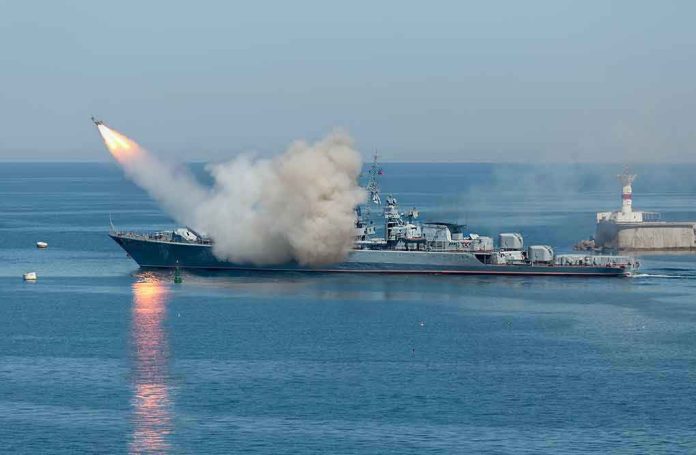
The United States Navy now has enough vertical launch cells for a major war—but not enough missiles to fill them even once.
Story Snapshot
- The fleet fields about 10,000 vertical launch cells, but current missile stocks cannot reload them a single time.
- Years of low Tomahawk and air defense missile buys collided with record use in wars against Iran and the Houthis.
- The Navy is now asking for a 1,200% jump in Tomahawk funding and backing big factory expansions to catch up.
- Analysts warn that, even with new contracts, rebuilding stocks to safe levels will take most of the next decade.
A Navy Built to Launch Missiles, Without Missiles to Load
Internal Navy assessments and outside studies now agree on a stark fact: the United States has built a fleet with about 10,000 vertical launch cells, but does not have enough missiles in inventory to fill them even once. These cells sit on cruisers, destroyers, and other warships and can fire Tomahawk cruise missiles, Standard air defense missiles, and other weapons. Those tubes are the sharp edge of American sea power. Empty or half-full tubes mean less real combat power, no matter how modern the ships look.
Reporting from Military.com and the National Security Journal shows how the shortage grew. Between late 2023 and early 2025, Navy ships fired more air defense missiles at Houthi drones and rockets than in the previous three decades after Desert Storm. They also launched hundreds of Tomahawk cruise missiles at targets in Yemen and later in the Iran war. One carrier strike group alone fired 155 defensive missiles and 135 Tomahawks, an enormous burn rate for a peacetime Navy.
How Years of Underbuying Collided With Wartime Use
Pentagon budget documents show that Tomahawk buys were very low in the years just before this surge in combat. The Navy bought 68 Tomahawks in 2023 and only 34 in 2024, with plans for 22 in 2025 and 57 in 2026. Analysts note that these levels barely keep the production line alive and fall far below the hundreds used in recent conflicts each year. At the same time, the fleet had already purchased thousands of missiles over past decades, leading many people to assume stocks were safe until the recent wars proved otherwise.
Think about what this looks like from the outside. On paper, the United States holds roughly 17,000 missiles that can fit in those vertical launch cells when you add up Standard Missile air defense rounds and Tomahawk land-attack cruise missiles. That sounds like a big number. But because the Navy has about 10,000 cells and must spread different missile types across many missions and theaters, that total cannot fully reload the fleet once. In a long fight against a major power, commanders could face painful trade-offs about which ships stay fully armed.
Rush to Rebuild: Bigger Contracts, Bigger Factories
Navy leaders and defense firms are now racing to close the gap, even as critics say the push is years late. The Navy’s 2027 budget request asks Congress for about $3 billion to buy 785 Tomahawk missiles and to fund “Tomahawk modifications” that upgrade older missiles. That is roughly a 1,200 percent increase in Tomahawk procurement compared with 2026 and marks a sharp turn away from the earlier pattern of small, uneven buys. The service also wants more air-to-air missiles and other weapons to help refill magazines across the force.
Raytheon, now part of RTX, has responded with large expansion plans for its missile plants. In February 2026, RTX announced five framework agreements with the Department of Defense to expand production of key munitions, including Tomahawks. The company said it aims to push Tomahawk output to more than 1,000 missiles per year over a potential seven-year span, a fourfold increase over the minimum sustainment rate. The firm is upgrading facilities in places like Tucson, Huntsville, and Andover to handle the surge and to add resilience after years of “just-in-time” manufacturing.
Why Both Sides of the Aisle See a Broken System
For many Americans, this story hits a nerve that runs deeper than missile math. Taxpayers have funded the world’s most expensive Navy, yet the people in charge let the magazines run low even while warning about China, Iran, and other threats. Conservatives see more proof that Washington elites prefer complex warship programs and defense-industry games over basic readiness. Liberals see another case of huge Pentagon budgets that still fail to deliver real security for regular citizens at home.
Both views point to the same core worry: a system that seems to serve itself first. Heritage Foundation analysts, not exactly anti-defense voices, argue that the Navy needs steady, multi-year missile contracts instead of boom-and-bust buying that scares industry away from investing. Other experts warn that suppliers for key parts, like solid rocket motors, have been allowed to shrink into fragile monopolies that cannot easily surge in a crisis. That kind of brittleness looks less like strength and more like a house of cards, especially to families with kids in uniform.
What This Means for the Next Crisis
For now, officials say the United States still has around 3,000 Tomahawks and many thousands of other missiles in storage, enough for current operations if wars do not widen. But Navy leaders have already told Congress that stocks are “dangerously low” from a planning point of view and that they cannot fully load the fleet across all missions. Independent analysts estimate that rebuilding Tomahawk and air defense missile inventories to safer levels will likely take the rest of this decade, even if new contracts and plant upgrades stay on track.
That timeline carries a hard lesson that both right and left can recognize. When Washington waits for a crisis before fixing basic gaps, regular Americans pay the price—in risk, in dollars, and sometimes in lives. A Navy with 10,000 launch cells but too few missiles looks a lot like the broader federal government today: big, expensive, and impressive on paper, but struggling to deliver when it counts. The question now is whether leaders will use this scare to rebuild real capacity, or slide back into business as usual once headlines fade.
Sources:
19fortyfive.com, cbsnews.com, youtube.com, aei.org, rtx.com, militarytimes.com, facebook.com, en.wikipedia.org