

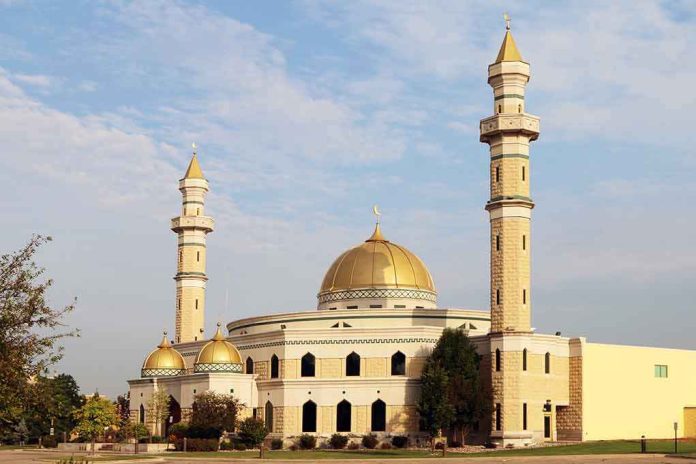
Two teenagers walked into a San Diego mosque with rifles, a live-stream running, and a plan soaked in hate—and still, 140 children walked out alive.
Story Snapshot
- A security guard and two congregants died buying time for children to escape locked-down classrooms.
- Police say the teenage shooters met and radicalized online, then live-streamed their attack.[1][5]
- Investigators recovered more than 30 guns, a crossbow, and hate-filled writings tied to the suspects.[1][5]
- Key motive evidence and timelines remain locked in case files the public has not seen.[1][2]
The Morning The Runaway Call Turned Into A Live-Streamed Massacre
San Diego police say the chain started with what sounded like a family problem, not a terror alert. Around mid-morning, a mother called about a runaway teenage son, missing guns, a missing vehicle, and a friend dressed in camouflage. Officers pushed the license plate into automated readers and warned a nearby high school connected to the boy. While they did that, authorities say, the same teens drove toward the Islamic Center of San Diego with rifles, cameras, and a script they intended the world to watch.[1]
Reports from the briefing describe the teens firing in the parking lot and then toward the mosque, broadcasting the attack live online as they moved.[3][5] A landscaper down the street came under fire and survived; three Muslim men at the center did not.[3] The official chronology says the shooters never reached the classrooms because the first line of resistance appeared in the doorway: a middle-aged security guard who understood he was badly outgunned and still stepped into the open.[1][3]
The Security Guard Who Stood Between Rifles And 140 Children
The guard, Ameen Abdullah, worked security but lived like many immigrant fathers: quietly, steadily, rarely in the news.[4] That changed the second he spotted the gunmen. Police Chief Scott Wahl told reporters that Abdullah’s response—calling a lockdown, confronting the attackers, returning fire—“delayed, distracted, and deterred” them from reaching the school wing.[1] Inside that wing, officials and the imam say roughly 140 children huddled in locked classrooms while gunfire echoed through their place of worship.[3][4]
Abdullah died in that gun battle, but not alone. Imam Taha Hassane identified the other two victims as Mansour Kaziha and Nadir Awad, both deeply embedded in the community.[4] Kaziha, according to the imam, was the first to dial 911 and stayed engaged until he was shot.[4] Another congregant reportedly ran back into the building after Abdullah fell, trying to help and losing his life in the process.[3][4] Law enforcement officials and the imam now describe all three as heroes whose sacrifice is directly linked to those children going home that day.[1][3]
Teenage Suspects, A Car Full Of Weapons, And A Trail Into The Digital Underworld
Police and the Federal Bureau of Investigation (FBI) say the gunmen were 17 and 18 years old, later found dead inside their vehicle from apparent self-inflicted gunshot wounds.[3] That vehicle, they report, held writings soaked in religious and racial hatred—targeting Muslims, Jews, women, black Americans, and pretty much everyone outside their nihilistic bubble.[4][5] Investigators executed at least three search warrants, seizing more than 30 guns, a crossbow, ammunition, tactical gear, and electronics from locations tied to the teens.[1][5]
FBI officials told the public that these teenagers met online and were radicalized in digital spaces littered with gore, extremism, and anonymous encouragement.[3][5] Reporters who reviewed some of the writings describe a “wide umbrella of hate” with no pretense of coherent ideology—only rage and contempt.[3] One document even looked like it might have been generated by artificial intelligence, raising unsettling questions about how easily modern tools can package hate for unstable minds.[3] For parents who still think the internet is just games and homework, that detail should be a five-alarm siren.
What We Still Do Not Know, And Why That Matters
Most of what the public “knows” about this attack comes from microphones, not from case files. Officials acknowledge that they have not released the police incident report, warrant affidavits, autopsy findings, ballistic reconstructions, or full dispatch logs.[1][2] News outlets show the podium, not the paperwork. That gap matters, because Americans are being asked to accept sweeping claims about motive and radicalization while the underlying evidence stays sealed inside government folders.[1][5]
❌ FALSE
Musk posted: "San Diego police are refusing to name yesterday's mosque shooters"
The claim is not supported by current…
📰 San Diego Police Department / press briefing coverage via YouTube · AP News — Coverage of the San Diego Islamic center shooting#factcheck
— Truth Checker (@truthcheckr) May 19, 2026
Even the basic timeline carries some static. Different broadcast packages stamped the incident with conflicting dates, a small but telling sign of how messy the information stream became.[1][2] Conservative common sense says: honor the dead, protect the living, but insist on receipts. If this was a hate-driven, online-fueled attack, the public deserves to see the writings, the digital trail, and a minute-by-minute reconstruction of how a “runaway juvenile” warning turned into a live-streamed firefight in a mosque parking lot.[1][3]
Why This Story Is Bigger Than One Mosque, One City, Or One Hate Crime Label
America keeps replaying a dangerous pattern. A brutal act happens; officials brief the cameras; the first storyline hardens before the lab reports dry.[1] Here, the storyline centers on three Muslim men whose courage almost certainly prevented a mass slaughter of children, and on two boys who walked into an online swamp and came out believing mass murder was content.[1][3][5] That framing is powerful—and largely consistent with what has been shared—but it is not the whole ledger.
For citizens who still believe in due process, transparency, and parental responsibility, this case should trigger three demands. First, full release of timelines, dispatch logs, and body-camera footage once investigative needs allow. Second, a hard look at the digital cesspools that helped mold these teenagers, without using the tragedy as an excuse to crush lawful speech. Third, a cultural reset where we praise genuine courage—like Abdullah, Kaziha, and Awad—at least as loudly as we amplify the killers who wanted a viral clip.[1][3][4][5]
Sources:
[1] YouTube – WATCH: San Diego officials hold press briefing on deadly …
[2] Web – WATCH LIVE: San Diego police update on deadly mosque …
[3] YouTube – San Diego shooting: victims identified in mosque attack
[4] YouTube – ‘They tried to protect’: Islamic Center Imam identifies victims …
[5] YouTube – San Diego Mayor says mosque shooting suspect …