

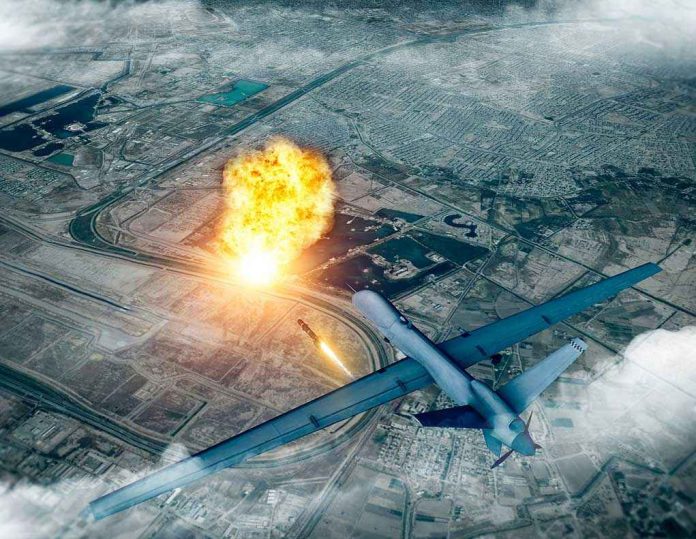
Ukraine’s newest long-range drone blitz set oil and military-linked targets inside Russia ablaze, exposing how modern war now reaches deep into home front infrastructure while leaders argue over whether that is defense or dangerous escalation.
Story Highlights
- Ukraine said the strikes were part of a “long-range” campaign to pressure Russian war-making capacity [6].
- Reports cited hits on a St. Petersburg oil terminal and other energy or military-related facilities [5][6].
- Russian officials reported disruptions to civil services, including airport operations and mobile networks [6].
- The campaign follows a pattern of targeting dual-use sites that fuel logistics and the wider war economy [7].
What Happened: Deep Strikes Land Near Russia’s Economic Showcase
Ukrainian long-range drones struck targets across Russia, including near St. Petersburg, as Russia hosted a flagship economic forum often cast as its answer to Davos. Reports described fires and smoke rising from oil-related infrastructure and other facilities in the city and surrounding Leningrad region [6]. A separate account said the drones reached more than 1,000 kilometers to hit an oil terminal in Russia’s second-largest city [5]. Kyiv framed the operation as aimed at energy and military-linked sites rather than random civilian locations [6].
Open-source coverage indicated that dozens to hundreds of drones were launched across multiple regions in a coordinated wave, with some focusing on St. Petersburg and others on strategic facilities deeper inside Russia [1][6]. Broadcast segments and posts amplified footage of burning storage tanks and emergency responses, which Kyiv’s leadership highlighted as proof that Russian war-supporting infrastructure remains vulnerable far from the front lines [6]. Russia’s communications emphasized defense responses and the resumption of services after temporary suspensions at transport hubs [6].
Competing Claims: Defense by Disruption vs. Escalation Risk
Ukrainian officials cast the strikes as a form of “long-range sanctions,” arguing that disrupting fuel logistics and defense-linked production constrains Russia’s ability to wage war and pressures Moscow amid slow-moving diplomacy [6]. This logic mirrors prior Ukrainian campaigns that targeted airbases, drone storage, and defense-industry facilities inside Russia to degrade supply chains and morale [7]. Kyiv’s message suggests these sites constitute legitimate military objectives when they directly feed battlefield operations and sustain combat tempo [6][7].
Russian authorities presented a different narrative, labeling the hits as attacks on infrastructure inside sovereign Russian territory that disrupted daily life, including temporary flight suspensions and connectivity outages around St. Petersburg [6]. Coverage emphasized that a fuel terminal—closely entwined with civilian energy needs—was struck, bolstering claims that Ukraine crossed a line by threatening critical services [5]. Moscow’s framing seeks to paint the campaign as reckless escalation that endangers civilians even when the stated targets are dual-use industrial nodes [5][6].
Why Dual-Use Targets Drive Confusion—and Strategy
Modern drone warfare repeatedly centers on dual-use assets like oil terminals, refineries, airbases, and defense-industry plants, because they sit at the intersection of military logistics and the broader economy [7]. Ukraine claims its targets are components of Russia’s war machine; Russia argues they are civilian infrastructure essential to daily life. That classification dispute often cannot be settled quickly from open sources, because damage assessments, facility ownership, and on-site functions are not always verifiable in real time [7]. The ambiguity is part of the strategic calculus.
🔴 BREAKING: —Zelenskyy Warns Russia: ‘Every Act of Aggression Will Receive a Response’!
📍Kyiv, June 6, 2026 (HewadPress) — Ukrainian President Volodymyr Zelenskyy announced that Ukrainian long-range drone strikes have successfully targeted key Russian military and energy… pic.twitter.com/FeAtrh3Cov
— HewadPress (@HewadPress) June 6, 2026
For audiences across the American political spectrum, this episode underscores a hard truth: twenty-first-century conflict erodes the old line between the front and the home front. Drones are cheap enough and smart enough to bypass traditional defenses and hit the infrastructure that powers armies and economies alike. Ukraine’s campaign seeks to impose costs without a traditional air force, while Russia underscores civilian disruption to win the narrative war. Both sides understand that public perception can shape diplomatic leverage as much as battlefield outcomes [5][6][7].
U.S. Relevance: Power, Accountability, and a Shifting Security Map
For Americans wary of endless wars and skeptical of government candor, these strikes highlight how quickly advanced technology can broaden conflicts and complicate alliances. Lawmakers will face pressure over aid, sanctions, energy markets, and air defense cooperation as dual-use targeting expands. Voters hearing about “surgical precision” will still see fuel depots burning on their screens. That gap between official assurances and visual evidence feeds distrust that officials, in Washington and abroad, protect elites and narratives first, and citizens last [5][6][7].
What to Watch Next: Infrastructure, Retaliation, and Negotiating Space
Analysts will track whether Ukraine sustains the pace of long-range strikes, whether Russia hardens energy and defense sites effectively, and whether either side shifts to talks under pressure. Repeated hits on logistics hubs could tighten fuel supply in contested regions, shape operations on the front, and strain repair crews. If retaliatory cycles intensify, civilian risk and insurance costs could spike, including for shipping and cross-border trade. Each development will test claims about lawful targeting and proportionality in the court of global opinion [5][6][7].
Sources:
[1] Web – Mass Ukrainian Drone Strikes Target Russian Military Facilities
[5] YouTube – Ukrainian drones strike St. Petersburg on Putin’s “Davos” opening day
[6] Web – Ukrainian drones strike a St. Petersburg oil terminal ahead of Putin …
[7] Web – Ukraine Attacks Energy, Military Sites In St. Petersburg Ahead Of …