

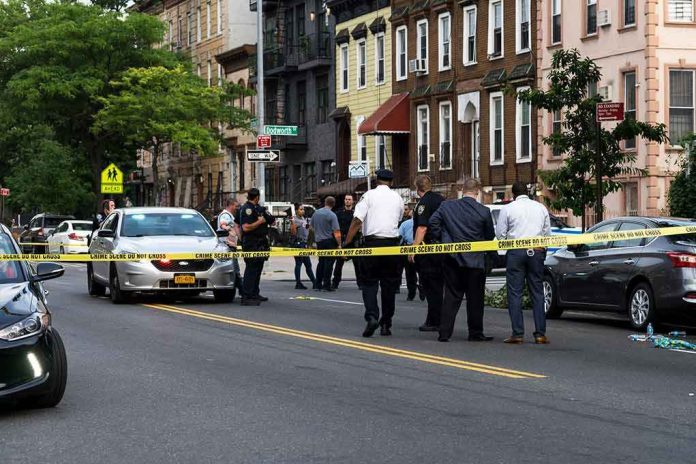
When a 22-year-old Penn State student is gunned down on his own South Philadelphia block in what appears to be a fight over a cell phone, it feels less like an isolated crime and more like another sign that basic public safety is slipping beyond the reach of ordinary Americans.
Story Snapshot
- A Penn State senior was shot and killed just steps from his South Philadelphia home after a late-night confrontation involving his cell phone.[1][3][5]
- Surveillance video reportedly shows a phone thrown, a brief chase, and the gunman turning back to shoot, while the victim can be heard asking for his phone.[1][4][5][6]
- Police have not announced a motive or arrested a suspect, even as media headlines frame the case as an attempted robbery over a phone.[1][3][4][5]
- The case highlights growing public anger that government cannot provide basic safety, even on the streets outside people’s homes.
What Happened On A South Philadelphia Block
Philadelphia police say 22-year-old Penn State student William “Billy” Schmidt was fatally shot around 1:30 a.m. on the 1900 block of Durfor Street, about a half block from the home where he lived with his family.[1][3][5] Officers responding to a report of a person with a gun found him in the street with a gunshot wound to the chest and rushed him to Penn Presbyterian Medical Center, where he was pronounced dead shortly afterward.[2][3] He had been walking home from a nearby bar after watching the professional basketball finals with friends.[3][5]
Local outlets report that the entire encounter unfolded in seconds, not miles away but literally on the victim’s own block.[1][3][5] Neighbors turned over security camera footage to investigators, helping reconstruct the final moments.[1][5] For many residents in cities like Philadelphia, that detail stings: the danger is no longer just in “bad neighborhoods” or late-night hot spots, but on the short walk from a corner bar to the front steps, in places where families have lived for decades.[1][3]
Family, friends, classmates, and the Penn State community are mourning the tragic loss of Billy Schmidt, a 22-year-old student whose life was cut short in a fatal shooting early Sunday morning, June 7, 2026, in South Philadelphia. According to
READ MORE… https://t.co/eoynu0ML2B— Anuga ZZ (@anuga37955) June 7, 2026
Cell Phone Confrontation Caught On Camera
Surveillance video described by multiple stations shows a sequence centered on a cell phone.[1][3][4][5][6] In one clip, a man is seen throwing a phone; seconds later, another person runs around a corner with Schmidt chasing him, before the gunman turns and fires a shot into Schmidt’s chest.[1][3][5] A neighbor’s video reportedly captures Schmidt pleading for his phone to be returned just before the gunfire, and his father later found the device under a parked car and gave it to police.[1][4][5][6]
Reporters and Schmidt’s family have framed the incident as an apparent attempted robbery, saying the killers stole his phone and that he chased after them.[1][2][4][5] Philadelphia’s major outlets have repeated this storyline, and one television report bluntly declares he was shot after being robbed of his phone.[4][6] At the same time, police have publicly said only that the incident “appears” to be an attempted robbery and have not formally released a motive.[1][3][5] That gap between emotionally powerful narrative and limited official detail is exactly where distrust in institutions tends to grow.
No Arrests, Few Answers, And A Familiar Pattern
Despite the surveillance clips, witness cooperation, and an identifiable crime scene, police have not announced any arrests or named suspects in the killing.[1][3][4][5] Investigators are asking the public for tips and urging anyone who recognizes the young men in the videos to come forward.[3][4][6] For the family, the lack of progress is agonizing; for many citizens, it reinforces a sense that when ordinary people are victimized, the system moves slowly, if at all, while political fights in Washington move at full speed.[1][4][5]
The way this case is being covered also fits a broader media pattern. Limited video and raw grief from relatives quickly produce a vivid narrative—in this case, a robbery over a phone—long before prosecutors file charges or lay out a full evidentiary record.[1][4][5][6] Multiple outlets rely on the same porch-camera description, which can create the impression of independent confirmation when everyone is really working from the same short clip.[1][3][5] That does not mean the robbery story is wrong, but it does mean the public is being asked to fill in a lot of blanks.
Why This Story Resonates Beyond Philadelphia
For many Americans on both the left and the right, Schmidt’s death feels like another data point in a larger failure: government’s inability to deliver basic public safety while political leaders trade talking points.[1][3][5] Residents see a young man studying digital journalism and media, preparing to graduate, cut down on his own block over a device that is now cheap and ubiquitous.[3][5][6] They hear his father calling the killing “abhorrent” and “unbelievable,” saying no one should die “over a phone,” and they wonder why streets still feel lawless despite decades of promises and record government spending.[2][4][6]
Conservatives see soft-on-crime policies, overloaded courts, and a culture that seems to excuse almost anything.[1][2][5] Liberals see a city system that fails both victims and at-risk youth while money flows to well-connected interests instead of safer neighborhoods and better opportunities.[1][3][5] Both sides see a government that struggles to solve straightforward problems: keeping families safe where they live, delivering timely justice when someone is murdered, and communicating clearly about what is known and what is not in high-profile cases like this one.[1][3][4][5][6]
Sources:
[1] Web – A Penn State Student Was Murdered Over a Cell-Phone In A South …
[2] Web – A Penn State student was shot to death in South Philadelphia, police …
[3] Web – Penn State student fatally shot near South Philadelphia home
[4] Web – Penn State senior Billy Schmidt fatally shot near his South …
[5] Web – Penn State student shot, killed near South Philadelphia home in …
[6] Web – 22-year-old PSU student shot to death in South Philly – Audacy