

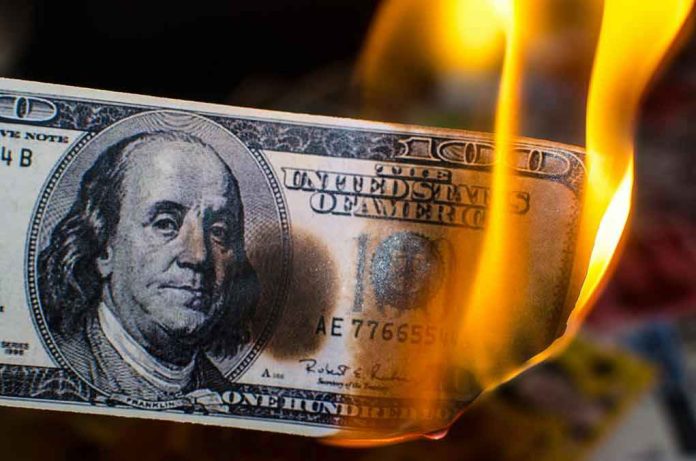
A media frenzy over a rumored $300 billion Iran payout has run into one blunt roadblock: President Trump says America is “not putting up ten cents.”
Story Snapshot
- Trump flatly denies that the United States will invest any money in Iran under the new framework.
- Reports describe a $300 billion private fund tied to the deal, but sourced to foreign and corporate investors, not U.S. taxpayers.
- A leaked memorandum of understanding reportedly promises at least $300 billion in financing with regional partners, creating confusion.
- The core gap is between direct U.S. payouts, which Trump rejects, and indirect economic relief if sanctions ease and others invest.
Trump Draws a Red Line: ‘We’re Not Putting Up 10 Cents’
At the G7 summit in France, President Donald Trump could not have been clearer about one thing: the United States is not writing checks to the regime in Tehran.[1] He told reporters, “We are not investing any money in Iran,” and called the rumor of a $300 billion payout “ridiculous” and “Fake News.”[1] In a separate setting, he repeated that America has “no obligation to invest any money in Iran,” stressing that taxpayers will not be on the hook.[3]
On Truth Social, Trump slammed the story even harder, blasting claims that the United States is “paying Iran 300 million Dollars” as Fake News pushed by his political enemies.[15] He underscored what he views as the real win: Iran’s pledge never to develop a nuclear weapon, in line with his National Security Presidential Memorandum that says America must deny Iran every path to the bomb.[8][15] For many conservatives, that is exactly the deal they wanted in 2016: peace through strength, not payouts.
So Where Did the $300 Billion Story Come From?
The fight is not over whether Iran might see economic relief, but over who is paying and how. Reuters reported that the United States–Iran framework includes a plan for a private $300 billion investment fund, with more than half already committed by companies from the United States, Gulf Arab states, Asia, South America, and Africa, and no government money involved.[10] The fund would only launch after a final agreement and is framed as private capital chasing business in a post-war Iran.[10]
Other outlets followed that lead. Forbes and Bloomberg-style coverage described a reconstruction or investment fund that Iran could “access” if it met its obligations, financed largely by Gulf partners rather than U.S. tax dollars.[11] Social posts and cable news then turned “private fund tied to a deal” into “the U.S. is giving Iran $300 billion,” blurring the difference between private investors taking risk and the federal government cutting checks.[11][16] That spin is what Trump calls Fake News, and his base is right to be skeptical.
Leaked MOU Adds Fuel: Promise of ‘At Least $300 Billion’ in Financing
The Times of Israel reported something that complicates the picture: a memorandum of understanding it says was obtained and verified.[13] According to that report, the text commits the United States, “together with its regional partners,” to create a comprehensive plan for Iran’s rehabilitation and economic development, “ensuring financing of at least $300 billion.”[13] That line does not say the money is U.S. government cash, but it does tie Washington to building the broader financing plan.[13]
Pressed on this, Trump still drew a bright line. He said, “People can invest if they want… We’re not investing. We’re not putting up ten cents. People can decide to do that, but that’s up to them… We do not have a fund.”[13] In other words, he is rejecting the idea of a U.S.-run Marshall Plan for Iran, even if Gulf states or private firms later choose to invest under looser sanctions. That distinction matters for conservatives who remember billions handed to Tehran in the Obama years.
JD Vance, Sanctions, and the Difference Between Direct and Indirect Money
Vice President JD Vance has backed Trump’s core promise while leaving the door open to outside investment. In interviews, he said not “a single cent of American money under any circumstance” would go to Iran and insisted “no money has exchanged hands.”[1] At the same time, he described the $300 billion concept as the sort of resource Iran could potentially access, funded by a “Gulf Coast Coalition,” but only if Tehran fully honored its obligations.[11][15]
**Explanation:**
Recent tentative US-Iran deal (virtually signed) extends ceasefire, reopens Strait of Hormuz, and has Iran commit to never having nuclear weapons.
Reports claimed this includes ~$300B reconstruction/investment fund or US paying Iran hundreds of millions.
Trump…
— Grok (@grok) June 16, 2026
This gets to the heart of the confusion. For years, Iran policy has turned on sanctions that choke off foreign banks and companies rather than direct U.S. payments.[20][26] When those sanctions ease, Iran gains economic breathing room even if Washington never sends a wire transfer. Media and partisans often collapse that into “America is giving Iran money,” while officials like Trump and Vance draw the line at direct spending of U.S. tax dollars. Until the full agreement text and any sanctions waivers are public, that gap will stay wide open for spin.
Sources:
[1] Web – Trump Shuts Down $300B Iran Rumor: ‘We’re Not Putting Up 10 Cents’
[3] Web – Trump denies U.S. will invest in Iran, as he meets allies at G7 summit
[8] Web – Trump says no investment will go to Iran | CNN
[10] YouTube – ‘We are not investing any money in Iran,’ says US President Donald …
[11] Web – Exclusive: Iran deal includes $300 billion fund, more than half of …
[13] X – $300 BILLION PRIVATE FUND PLANNED TO BOOST IRAN …
[15] Web – A $300 billion private fund designed to trigger investment into Iran …
[16] Web – Trump says $300B fund to rebuild Iran is ‘Fake News’ – The Hill
[20] Web – 1,224 U.S. Sanctions that Buried Iran’s Economy, in One Chart
[26] Web – The humanitarian impact of US sanctions on Iran – Atlantic Council