

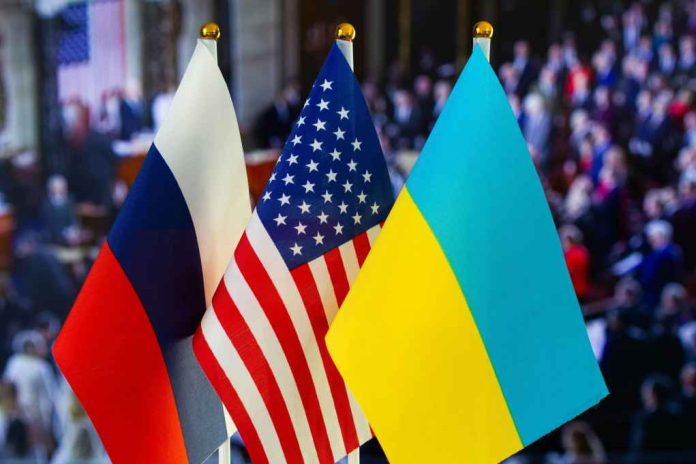
As Washington and Tehran inch toward a ceasefire deal, Moscow is loudly backing it, blaming America and Israel for the crisis, and reminding everyone that the real power brokers may not be sitting in Congress.
Story Snapshot
- Russia publicly supports the new US-Iran memorandum and calls for it to be signed this week.
- Moscow urges a ceasefire and criticizes US and Israeli “aggression,” while claiming to back regional stability.
- Russia has a long-term strategic partnership with Iran, including defense and intelligence cooperation.
- Experts say Russia uses Middle East “peacemaking” to gain leverage against the US and project great-power status.
What Russia Is Saying About The US-Iran Deal
Russian Foreign Minister Sergei Lavrov said Moscow “hopes” the new agreement between the United States and Iran will be signed this week, echoing signals from Washington, Tehran, and Pakistan that a memorandum of understanding is close.[3] Russian officials have also warned that any new United States strike on Iran would bring “serious consequences” and say they want Iran to keep a peaceful nuclear program under strict terms, not to build a bomb.[2] Moscow is pushing a message of de-escalation while appearing to side with Iran against Western pressure.
At the same time, Russia’s Foreign Ministry is blaming the United States and Israel for the wider Middle East crisis, calling their actions “aggression” that pushed the region toward an abyss.[4] The ministry has urged an “immediate ceasefire” and condemned strikes on Arab states in the Gulf, trying to present Russia as a responsible power calling for restraint.[4] Lavrov has also repeated that Moscow sees no proof Iran is developing nuclear weapons, again putting Russia closer to Tehran’s talking points than to Washington’s.[5]
Russia’s Deep Ties With Iran Behind The Peace Talk
Behind the soft talk about peace and mediation sits a much harder reality: Russia and Iran are not neutral partners but strategic allies. Analysts note that the two countries signed a 20-year strategic partnership in 2025 covering security, defense industries, military training, and intelligence-sharing, locking in long-term cooperation against Western pressure.[11] Research on the relationship says it is driven by shared fears about regime survival and sanctions, and by a shared goal of pushing back against United States influence in the region.[10]
Open-source reporting shows Iran has supplied Russia with attack drones and helped Moscow set up local production lines, which Russia then used in its war in Ukraine.[12] Studies also describe growing military technology cooperation, arms sales, and intelligence sharing between the two countries since 2022, including suspicious “dark” port calls linked to weapons transfers.[12] Russia is also described as Iran’s main arms supplier and a key economic and military partner, with both states heavily sanctioned by Western governments.[13] All of this makes Russia look less like a neutral referee and more like Iran’s senior partner playing a careful game.
How Moscow Uses Mediation To Boost Its Power
Experts on Russian diplomacy say Moscow treats conflict zones like the Middle East as places to gain leverage and show it is still a great power, not just as chances to do peacemaking.[22] One study describes Russia’s style as “coercive diplomacy,” mixing hard power, arms sales, and deals with offers to mediate and calls for ceasefires.[22] In practice, Russia often works both sides: it sells weapons to Iran and backs Tehran in the United Nations, but also talks with Israel and Arab Gulf states and offers to calm things down when war risks spinning out of control.[16]
The Iran-US MoU and it Ramification:
A) Nuclear deals yet to be agreed but it will be on lines of JCPOA with some extended timelines. 3.67% enrichment for civilian nuclear use. Cap on enrichment timeline will decided later but will be 15-20 years. The already available…
— Navroop Singh (@TheNavroopSingh) June 17, 2026
That pattern is visible again in this US-Iran deal. Reporting shows Russian and Chinese ambassadors met Iranian officials in Tehran right before news of the memorandum broke, and experts say China and Russia helped shape the ceasefire terms.[1] Russia has also offered “mediation services” between Iran, Israel, and the United States in the past, while using strong language against United States strikes and promising to defend Iran’s “rights” on the nuclear issue.[5][15] This lets Moscow look like a peacemaker to some audiences and a defender of Iran to others, all while keeping pressure on Washington.
Why This Matters For Americans On The Right And Left
For many Americans, the details of a ceasefire memorandum in the Strait of Hormuz can feel far away from problems like rising prices, weak wages, and a government that never seems to listen. But this deal, and Russia’s role in it, hit at some core worries on both the right and the left. On one side, people see a foreign policy class that signs complex deals without clear votes in Congress, while rivals like Russia, China, and Iran gain more say over global energy and security.[1] On the other side, many see yet another example of great powers bargaining over war and peace while ordinary people, soldiers and civilians alike, pay the price.
Russia’s behavior also feeds growing distrust of “elites” and permanent bureaucracies. Moscow is stepping into a vacuum created by years of mixed United States policy toward Iran, moving from “maximum pressure” to sanctions relief to new understandings, often with little transparency.[10][19] As Russia and China insert themselves into deals that shape oil flows and regional stability, American voters watch Washington argue but rarely see lasting solutions. That fuels the feeling that the world is being run by distant actors—foreign and domestic—who trade away security and values behind closed doors.
What To Watch Next
The ceasefire memorandum between the United States and Iran is not yet public, and experts stress that it is a first step, not a full peace treaty.[7] Much will depend on what happens after the signing: how strictly Iran follows limits, how quickly United States forces ease their presence, and whether Israel feels its security is protected or sidelined. Reports already suggest Israel was kept at arm’s length during parts of the process, which could deepen mistrust between Washington and Jerusalem if the deal goes badly.[1]
For Americans trying to make sense of this, two questions are key. First, does the deal truly reduce the chance of a wider Middle East war that could spike energy costs and pull the United States deeper into another conflict? Second, does it come with real oversight and public debate, or is it another elite bargain shaped in part by rival powers like Russia and China? Those answers will reveal whether this is a step toward a safer, more accountable foreign policy—or another chapter in a story where ordinary citizens watch from the sidelines while the “deep state” and foreign strongmen redraw the map.
Sources:
[1] Web – Russia backs US-Iran deal, urges Israel to also comply: foreign …
[2] Web – US-Iran ceasefire deal shaped by China and Russia, experts say
[3] Web – Russia’s Lavrov Warns against Any New US Strike on Iran
[4] Web – Lavrov says Moscow hopes US-Iran pact will be formalized soon
[5] Web – Russia’s Foreign Ministry statement on the situation in … – Facebook
[7] YouTube – On TV, Russia Minister’s Nuclear Message On Iran To US …
[10] Web – In a dramatic escalation of global diplomatic pressure, #Russia and …
[11] Web – Strategic Transactionalism: The Iran-Russia Partnership
[12] Web – The Iran-Russia Strategic Partnership Agreement: Scope and Impact
[13] YouTube – How Did Russia and Iran Become Allies?
[15] Web – The Evolving Russia-Iran Relationship – CNA.org.
[16] Web – Iran–Russia relations – Wikipedia
[19] Web – Russia and Iran are seen as allies and it would be a severe setback …
[22] Web – Russian Policy in the Middle East in the Context of the Struggle …