

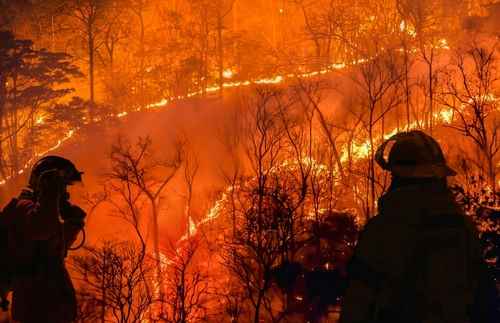
Three firefighters died in a fast-moving border wildfire, and the first reports still leave key questions unanswered.
Quick Take
- Three firefighters were killed and two were injured while responding to a wildfire on the Utah-Colorado border.
- Officials said the fire began in eastern Utah and later spread into Colorado after several blazes merged.
- Colorado Governor Jared Polis declared a disaster emergency and called in National Guard support.
- Early reporting says the firefighters were caught in a burnover, but the public record still lacks full forensic detail.
What Happened on the Border
Three firefighters died and two others were injured while fighting the Snyder wildfire along the Utah-Colorado border. The U.S. Wildland Fire Service said the crew was working the Knowles and Gore fires when the incident happened, and later reports said those fires merged with the Snyder Mesa Fire. The blaze was estimated at about 28,000 acres and was still listed at zero percent containment.
The naming has already created confusion in early coverage. Some reports call it the Snyder Fire, while others refer to the Snyder Mesa Fire or the Knowles and Gore fires. That kind of shifting label is common in fast-moving emergencies, but it can make it harder for the public to follow what happened, where it started, and which crew was in danger.
🚨 BREAKING: Three firefighters are dead after battling a wildfire along the Utah-Colorado border.
Officials say three wildland firefighters were killed while fighting the rapidly growing #SnyderFire. Two other firefighters were seriously injured and transported to the hospital… pic.twitter.com/Sdz47r50Lg
— Chase Thomason (@ChaseThomason) June 28, 2026
State Response and Fire Growth
Colorado Governor Jared Polis declared a disaster emergency on Saturday and authorized the Colorado National Guard to support response efforts. That move signals how quickly the fire had escalated across the border region. Officials also issued evacuation warnings for smaller communities in Mesa County, showing that the danger was not limited to the firefighters on the line.
The scale of the fire matters because it shows how much strain western states face during wind-driven wildfire events. Reports from the area said the blaze began as the Snyder Mesa Fire in eastern Utah’s Grand County before moving into Colorado and joining other fires. In plain terms, the fire did not stay local. It became part of a larger, wider emergency that stretched crews and resources.
What Officials Have Said So Far
The U.S. Wildland Fire Service has praised the firefighters’ bravery, dedication, and sacrifice, but it has not yet released the victims’ names or hometowns. It has also not given detailed medical updates beyond saying two firefighters are being treated for burn injuries. That leaves a gap in the public record, even as the incident has already become a major national news story.
The early description of the event as a burnover fits a known wildfire hazard, where crews are overtaken by sudden fire behavior. But the initial public statements do not give the full weather logs, tactical choices, or terrain details that would explain exactly how the crew was trapped. That matters because wildfire deaths often raise hard questions about training, decision-making, and whether the danger changed too fast to escape.
Why This Story Resonates Beyond One Fire
This incident is about more than one deadly blaze. It highlights a deeper problem that people across the political spectrum already feel: government systems often move slowly, explain little, and answer late. Families want names, facts, and accountability. Local communities want clear warnings and protection. Taxpayers want proof that agencies are learning from past failures instead of repeating them.
For now, the public has a basic outline but not a full explanation. Three firefighters are dead, two are hurt, and the fire keeps burning across state lines. Officials have moved quickly on emergency response, but the larger safety review has not yet caught up. Until investigators release more detail, the most important unanswered question remains simple: what went wrong on the line?
Sources:
[1] Web – 3 firefighters killed, 2 injured while tackling wildfires on the …
[2] Web – Three Firefighters Killed, 2 Injured in Snyder Wildfire on Utah …
[3] Web – 3 firefighters killed responding to Snyder wildfire on Utah-Colorado …
[4] Web – Three firefighters killed as wildfires rage across the Southwest …
[5] X – Three firefighters died and two were injured while tackling fires on …
[6] Web – Three firefighters killed, 2 injured in Snyder wildfire on Utah …
[7] Web – South Canyon Fire Entrapment Fatalities 1994
[8] Web – Three firefighters killed on Colorado-Utah border as wildfires …
[9] Web – 3 firefighters killed, 2 injured battling wildfires on Colorado-Utah …
[10] Web – 3 firefighters killed, 2 injured while tackling wildfires on the …
[11] Web – 3 Firefighters Killed, 2 Injured While Tackling Wildfires on …
[12] Web – 3 firefighters killed, 2 injured while tackling wildfires on the …
[13] Web – 3 firefighters killed, 2 injured fighting wildfires near Colorado-Utah …
[14] Web – Three firefighters killed while tackling major wildfires along …
[15] Web – [PDF] Investigating Wildland Fire Entrapments
[16] Web – [PDF] Wildland firefighter entrapment avoidance: modelling evacuation …
[17] Web – Entrapment Investigation & Lessons Learned
[18] Web – Predicting Firefighter Injury and Entrapment in Urban … – PMC – NIH
[19] Web – A review of US wildland firefighter entrapments: trends, important …
[20] Web – 21 issues identified in firefighter entrapment during wildfires.
[21] Web – Surviving Fire Entrapments – Colorado Firecamp