

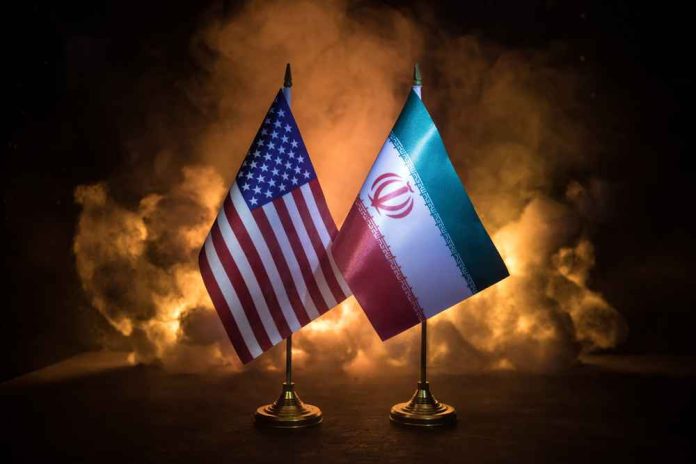
A peace deal that was supposed to end a war between the United States and Iran collapsed on July 8, 2026, after President Trump declared it “over” — and both sides launched fresh strikes on each other.
Story Snapshot
- Trump declared the Islamabad Memorandum of Understanding (MoU) “over” on July 8, citing Iranian attacks on three commercial ships in the Strait of Hormuz.
- The US military struck more than 80 Iranian targets, including air defense systems; Iran claimed it hit 85 US military sites in response.
- The MoU, signed June 17, gave both sides 60 days to negotiate a final deal — but neither side has provided independent proof of who broke it first.
- Both countries now accuse the other of starting the collapse, and no neutral party has verified either side’s claims.
How the Peace Deal Fell Apart
The Islamabad MoU was a 14-point framework signed on June 17, 2026, with Pakistan acting as mediator. It gave both sides 60 days to work toward a permanent deal. Under the agreement, Iran was required to allow safe passage for commercial ships through the Persian Gulf at no cost. The US, in turn, agreed to lift its naval blockade and hold off on new sanctions. The deal was fragile from the start — both sides had already broken the earlier April ceasefire “numerous times.”
Trump made his declaration at the North Atlantic Treaty Organization (NATO) summit in Ankara. He said Iran had attacked three commercial vessels — including tankers from Qatar and Saudi Arabia — in the Strait of Hormuz. He called Iran “vicious” and “violent” and said he no longer wanted to negotiate. The US military’s Central Command confirmed it had struck more than 80 Iranian targets, including air defense systems and radar installations, based on footage released late July 7. Iran responded by claiming it targeted 85 US military sites, though neither side’s specific claims have been independently verified.
🟦 MORNING BRIEFING: While You Slept — July 8, 2026
⭕ DEVELOPING
• Trump says the U.S.-Iran MOU is “over.”
• U.S. strikes hit Bushehr in southern Iran.
• Iranian attacks trigger sirens in Kuwait and Bahrain.
• NATO summit opens in Ankara as Iran, Turkey, Spain, and… pic.twitter.com/aCM2htSuKG
— ZIONS OF ISRAEL (@Israeli_Sniper) July 8, 2026
What the Agreement Actually Required
The MoU’s text is public. Point 5 required Iran to arrange safe passage for commercial ships for 60 days at no charge. Point 9 required both sides to maintain the status quo on Iran’s nuclear program and blocked the US from adding new sanctions during the negotiation window. Iran had also agreed to let International Atomic Energy Agency (IAEA) inspectors return and committed in writing to never seek nuclear weapons. The US lifted its naval blockade the day after signing, on June 18.
The agreement also included a key procedural requirement. Point 14 stated that any final deal would need endorsement from the United Nations (UN) Security Council. Trump’s announcement that the MoU is simply “over” does not follow that process. Whether that matters in practice — given that military action has already resumed — is a separate question. But it does mean the US walked away from a framework it helped write, without going through the steps that framework required.
Both Sides Point Fingers, But Proof Is Scarce
The core dispute is straightforward: the US says Iran attacked three commercial ships, breaking the MoU’s safe-passage requirement. Iran says the US violated the deal first by striking its Hormozgan province and Mahshahr port, which it described as violations of Article 1. Iran’s foreign ministry said US compliance was the key to keeping the deal alive. Each side’s claims rest almost entirely on its own statements. No independent maritime authority, satellite imagery, or neutral government has publicly confirmed who struck first or what exactly happened to the three ships.
That lack of verification is the most important thing to understand about this story. The US has not released independent evidence confirming Iran attacked the vessels. Iran has not released evidence confirming it hit 85 US military sites. The pattern here is not new — since the original April 8 ceasefire, both sides have traded accusations of violations without neutral confirmation. Americans on both the left and the right have reason to ask the same question: when the government tells us a war is justified, where is the proof? That question doesn’t take sides — it just demands accountability from people in power who are making decisions that affect every one of us.
Sources:
townhall.com, aljazeera.com, en.wikipedia.org, npr.org, instagram.com