

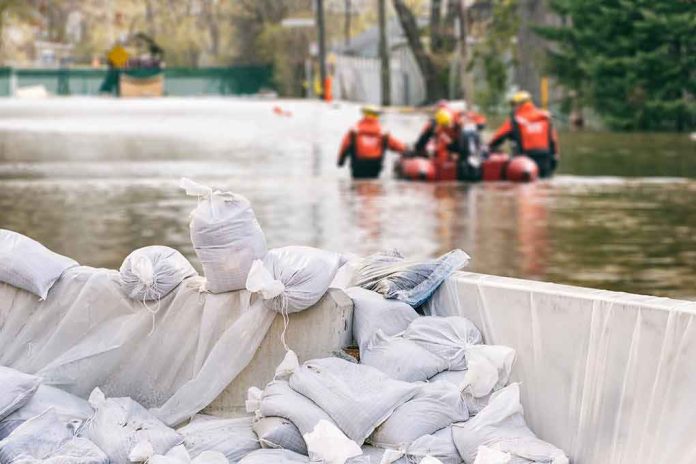
As deadly flash floods rip through West Virginia, the governor says some residents are still missing while crews race to find them.
Story Snapshot
- At least eight people are dead and at least one person remains unaccounted for after flash flooding in northern West Virginia.
- Governor Patrick Morrisey has declared a state of emergency and deployed the National Guard and other state resources to help local rescuers.
- Rescue teams and state police are going door to door, searching for missing people and checking damaged homes.
- Changing death and missing-person counts highlight how fragile communities are when disaster strikes and government systems are stretched thin.
Deadly flooding leaves victims missing and communities in shock
Flash flooding in northern West Virginia has killed at least eight people and left at least one person unaccounted for, according to Governor Patrick Morrisey’s latest public update. The floods hit hardest in Ohio County and Marion County after three to four inches of rain fell in a short time, turning roads into rivers and washing out bridges and homes. Families in these communities are now waiting for word on loved ones as officials track who has been found and who is still missing.
Earlier reports showed different numbers as the crisis unfolded, with officials at first saying five deaths and three missing, then six dead and two unaccounted for, and later seven fatalities and at least two missing persons. This kind of shifting count is common in fast-moving disasters, but it can deepen fear and distrust among people who already feel the system does not work for them. For many residents, every number is a name, a neighbor, or a family member, not just a statistic.
Governor declares emergencies and sends in the National Guard
Governor Morrisey has declared states of emergency in Ohio County and Marion County and later extended emergency status to all 55 counties in West Virginia as severe storms spread across the state. He has sent hundreds of National Guard members to the hardest-hit areas and mobilized other state resources to assist overwhelmed local crews. These troops and emergency workers are helping with water rescues, clearing debris, and supporting search efforts in neighborhoods cut off by washed-out roads and damaged infrastructure.
National Guard teams have carried out swift-water rescues and helped pull more than 100 people from flooded homes, stranded cars, and even a damaged shopping center. Local emergency managers report dozens of water rescues across north-central West Virginia as scanner traffic describes “life-threatening” situations and stranded residents. While many people have been saved, residents see how close the line is between survival and tragedy when storms hit faster than local governments and aging infrastructure can cope.
Search-and-rescue operations continue for the unaccounted
State police are going door to door in impacted areas, looking for people who may be trapped, injured, or unable to call for help. Rescue teams are working with lists from families, 911 calls, and local officials to track who is still missing and who has been found. The governor’s office says state officials are coordinating closely with local emergency responders to locate missing individuals, treat search operations as the top priority, and update the public as information changes.
News outlets and officials have used different phrases—“three unaccounted for,” “two unaccounted for,” “at least one unaccounted for”—as they confirm new rescues or recover additional victims. This highlights a painful truth in disasters: there is often a period when nobody can say exactly how many people are missing. For families on edge, that gap feeds the broader worry that government systems are reactive, slow, and more focused on press releases than on real preparedness.
A harsh test of infrastructure, preparedness, and trust
These floods struck in a country where many people on both the right and the left already doubt whether national and state leaders can protect ordinary citizens. Residents in West Virginia watched roads, bridges, and utility lines fail under a few hours of heavy rain, even though flooding is a known risk in the region. When basic infrastructure collapses so quickly, it reinforces the belief that political elites talk about safety and resilience but leave small communities exposed when storms and economic stress hit at the same time.
Over 500 National Guard personnel have deployed across north-central West Virginia as search and rescue efforts continue following catastrophic flash flooding.
Read more in the comments below.#wvnews #WVFlooding #PatrickMorrisey #BuckhannonWV #UpshurCounty #WVNationalGuard pic.twitter.com/IFWeT6jOaf
— The State Journal (@wvstatejournal) July 22, 2026
Governor Morrisey has said his office is working with the Federal Emergency Management Agency to respond to the disaster and support recovery. That federal help may ease the damage, but it does not erase long-standing frustrations. Many citizens see a pattern: warnings come late, sewers and drainage systems are outdated, and serious upgrades get delayed while leaders in Washington and state capitals focus on elections and partisan fights. The search for the unaccounted in West Virginia is not only about finding people today; it is also a stark reminder that, without real planning and accountability, the next storm could leave even more Americans wondering if anyone in power truly has their back.
Sources:
youtube.com, wvpublic.org, apnews.com, theepochtimes.com, governor.wv.gov, cbsnews.com