

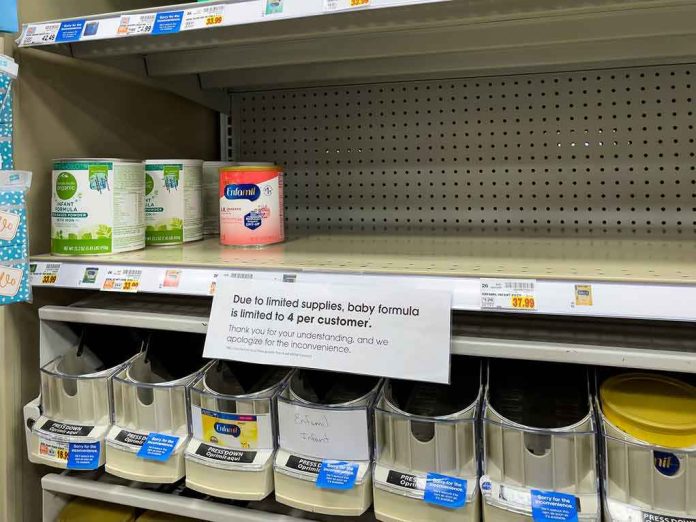
On Monday, September 14, the Justice Department announced that Abbott Laboratories will pay nearly $385 million to settle government claims tied to bacterial contamination at its Michigan baby formula plant — the plant whose 2022 shutdown emptied store shelves across the country. Four years later, the bill has arrived. It is payable to the federal government and a group of states, not to the parents who drove from store to store in 2022, and the company still says its formula was never the problem.
Story Highlights
- September 14: the Justice Department settlement resolves False Claims Act allegations linked to the Sturgis, Michigan plant.
- The money settles the government’s claims; families who paid for scarce formula during the shortage are not parties to the deal and receive nothing from it.
- Food and Drug Administration found Cronobacter bacteria in the plant environment during its 2022 probe; a federal consent decree forced safety upgrades before production could restart.
- Abbott says no unopened, distributed formula ever tested positive for Cronobacter.
Settlement Ties Up Federal And State Claims
The Department of Justice said Abbott Laboratories agreed to pay nearly $385 million to settle a civil False Claims Act case brought by the federal government and some states. The case stemmed from bacterial contamination findings at Abbott’s Sturgis, Michigan plant, which makes powdered infant formula. The payment ends a major enforcement action without a trial. The agreement does not change prior recalls or product testing records, but it resolves claims over how Abbott ran the plant during the period in question.
The settlement follows a turbulent period for U.S. families. The Sturgis shutdown in 2022 worsened a national formula shortage and strained trust in both industry and regulators. Parents saw empty store shelves while agencies and companies argued over testing, timelines, and fixes. The legal deal closes the government’s fraud claims, but it does not undo the stress families faced, and none of the money is earmarked for them. It does aim to lock in stronger controls going forward through separate court-ordered reforms.
What Investigators Found Inside The Michigan Plant
The Food and Drug Administration reported finding Cronobacter sakazakii in environmental samples at the Sturgis facility during its 2022 inspection and investigation. The agency’s summary described insanitary conditions and multiple positive environmental subsamples, which supported enforcement action. Cronobacter can survive in dry foods, including powdered formula, and can be dangerous to newborns with weak immune systems. Those findings helped build the case that the plant failed to meet required sanitation and safety standards that protect infants.
The United States filed a complaint and proposed consent decree that required Abbott to fix conditions and adopt strict safety measures before restarting formula production in Sturgis. The federal court entered a permanent injunction that bound Abbott to improved controls and oversight. The consent decree created a legal backstop, making future compliance mandatory, not optional. These steps reflected a common pattern in food safety cases, where inspections trigger court-ordered reforms to reduce risks.
Abbott’s Position On Product Safety And Testing
Abbott has said no unopened, distributed Abbott infant formulas have ever tested positive for Cronobacter sakazakii, and that Cronobacter found at the plant was in non‑product contact areas. The company also points to testing by both Abbott and the Food and Drug Administration during inspections that showed finished product samples were negative for Cronobacter and Salmonella. Those statements do not erase the environmental findings, but they address concerns about direct contamination of sealed formula on store shelves.
Baby formula maker Abbott Laboratories agreed to pay nearly $385 million to resolve a civil False Claims Act case with the Justice Department and some states stemming from a Cronobacter bacterial contamination at one of its plants in Michigan that manufactures powdered baby…
— CBS News (@CBSNews) September 14, 2026
Federal officials have also released broader testing data showing U.S. infant formula is generally safe from chemical contaminants like heavy metals and pesticides, which is a separate risk category from bacteria such as Cronobacter. That review reinforces that most products on the market meet safety expectations, even as regulators press manufacturers to harden their processes and supply chains against microbial hazards. The Food and Drug Administration continues to urge formula makers to tighten controls to prevent bacterial contamination events.
Why This Matters For Families And Oversight
The settlement signals that failures in basic safety practices will carry real costs, even for large companies. Parents on the left and right want clean plants, steady supply, and honest oversight. The consent decree and the payout show regulators can force change when companies fall short. But families also watched the shortage drag on while Washington and industry argued, and the check for it is going to Washington. Many feel the system protects leaders first and fixes for parents second. That trust gap is now the real risk to repair.
Sources:
cbsnews.com, justice.gov, fda.gov, abbott.com, cnn.com, efoodalert.com, aapc.com, foxbusiness.com