

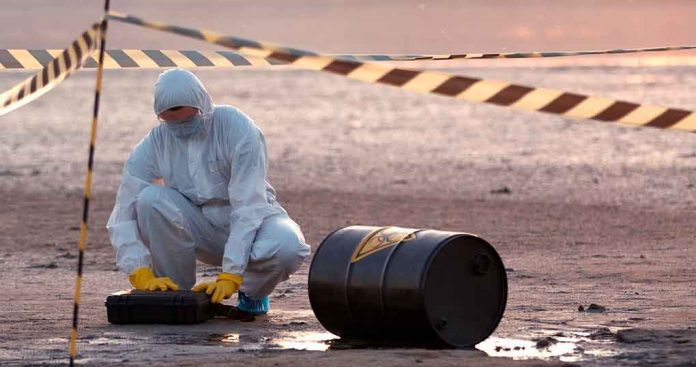
Oceanside police, fire, and the county bomb squad locked down a neighborhood after bottles labeled “biohazard” and “top secret” were found near a busy roadway.
Story Highlights
- Suspicious bottles and cans with “biohazard” warnings and “top secret” markings prompted a hazmat and bomb squad response in Oceanside.
- Crews shut Vandegrift Boulevard, set a perimeter, and told nearby residents to shelter in place.
- Officials later said there was no longer an explosive-hazard threat; no injuries were reported.
- Investigators have not publicly confirmed what was inside the containers as the probe continues.
Marked Containers Trigger Precautionary Lockdown in Oceanside
Authorities in Oceanside, CA responded Sunday morning to bottles and cans marked with biohazard warnings and the words “top secret” near Castellanos Drive and Vandegrift Boulevard at about 10:15 a.m., leading to a street closure and shelter-in-place orders for nearby blocks. Fire officials first sent a hazardous materials team, then called in the San Diego County Sheriff’s Bomb and Arson Unit as a precaution while crews worked to assess the risk. Officials later said there was no longer an explosive-hazard threat.
Responders shut Vandegrift Boulevard between Castellanos Drive and East Parker Street during the assessment and set a perimeter while specialists examined the containers from a safe distance. Residents in the 700 block of Arthur Avenue and the 4900 block of El Mirlo Drive were told to stay inside while the work continued. No injuries were reported as of the latest update, and the public was urged to avoid the area and follow instructions from emergency crews while the investigation remained active.
🚨☣️ SAN DIEGO, CALIFORNIA — BOMB SQUAD LOCKS DOWN STREET AFTER BOTTLES MARKED “BIOHAZARD” AND “TOP SECRET” FOUND
Category: Public Safety / Bomb Squad / Suspicious Materials
Date: September 13, 2026 — 9:19 PM ET
Location: San Diego, California
Status: 🟢 SCENE CLEARED / NO… pic.twitter.com/VbNKFrbpbc— WilluChill U.S. News. (@Will466513) September 14, 2026
How Bomb Squads Handle Suspicious Items in Public Areas
Explosive ordnance technicians and hazardous materials teams follow layered, cautious steps when they face suspicious items in public. Standard practice is to evaluate from the outside, using cameras, robots, and meters, and to keep people back until the scene is safe. Field guides direct officers to isolate the area, avoid contact, and bring in bomb specialists when a device or hazardous substance is suspected. These steps explain why roads close fast and why officials hold perimeters until they complete safety checks.
Perimeter distances and closures may feel disruptive, but they aim to reduce risk while information is scarce. Public-safety manuals call for clear standoff zones and coordinated alerts so crews can screen for explosives and any dispersal features without exposing the public to harm. In many past cases, a strong initial response ended with an all-clear once specialists verified no active device was present. That pattern reflects a “safety first” approach, not proof of confirmed danger at discovery.
What We Know So Far, and What Is Still Being Reviewed
Officials described multiple containers with caution tape, biohazard symbols, and “top secret” writing, which raised red flags and triggered the response timeline reported above. The fire department’s hazardous materials team moved first, then the county bomb unit joined as a safeguard while crews checked the contents and the surroundings. Authorities later stated there was no longer an explosive hazard and confirmed no injuries, but they did not release the number of items or the final substance findings on scene.
Investigators have not publicly identified what was inside the containers or who placed them there. The decision authority and exact time for lifting the shelter-in-place and adjusting traffic control were not named in the public reporting cited here. Those facts often follow later through incident logs, lab screens, and official summaries once evidence is processed. Until then, agencies tend to limit details while they secure items, log chain of custody, and rule out criminal intent.
Public Safety, Common Sense, and Respect for the Rule of Law
First responders acted to protect families, property, and daily life, and they did so by the book. Crews closed the road, isolated the area, and worked their checklists to prevent harm to bystanders and officers. That is how local, state, and federal partners are trained to handle potential explosive or biological risks in public places, even when the threat later proves low or nonexistent. This careful method supports order and frees neighborhoods from fear faster once experts clear the scene.
For our readers, the take-home is simple: caution beats regret. When odd markings and risky labels show up in a neighborhood, responders must assume the worst until they know better. That is not government overreach; it is good stewardship and personal responsibility applied at the community level. Here, that approach delivered a steady outcome: roads were secured, residents were protected, and the area was cleared with no injuries while investigators continue their work.
Sources:
nypost.com, yahoo.com, nbcsandiego.com