

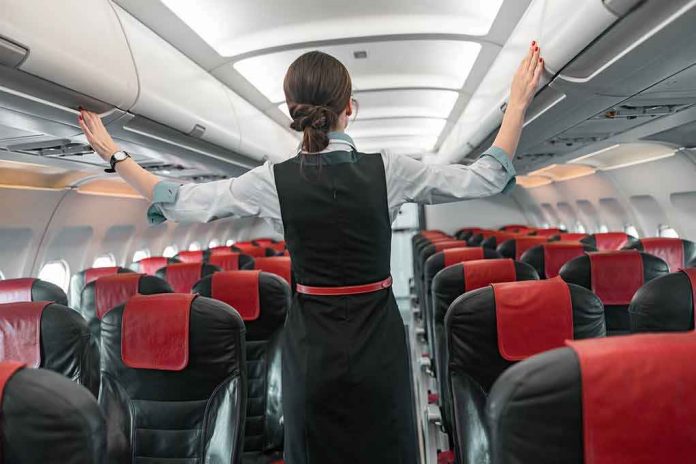
A flight dispute over a seat next to a woman turned into a criminal probe after police said the passenger cited Sharia law and then assaulted a female flight attendant.
Quick Take
- German police said initial witness statements linked the passenger’s refusal to his claim about Sharia law.
- Authorities said he later admitted to assaulting the flight attendant during questioning.
- Police also said he insulted officers in Turkish, which added another charge.
- The case is being handled as a criminal matter, not as a seating or religious accommodation dispute.
What Police Say Happened
German media reports, citing police, say the incident happened on a June 1 flight that landed in Düsseldorf. Officers said the man refused to stay in his assigned seat because a woman sat nearby. According to initial witness statements, he said Sharia law was the reason. When a female flight attendant tried to calm the situation, police said he struck her in the face and was arrested after landing.
Police then questioned the suspect after the plane landed. Reports say he admitted to assaulting the flight attendant and also insulted officers during the interview. That matters because it shifts the story from a verbal dispute to a clear criminal allegation. The key facts now in the public record are the refusal, the alleged blow, and the confession, not any accepted religious defense.
A plane passenger "invoked Sharia law" to avoid sitting next to a woman, then hit a flight attendant, according to German police.https://t.co/vFEd7uy7Ck
— ABC 13 News – WSET (@ABC13News) July 19, 2026
Why the Sharia Claim Matters
The Sharia claim is the part that drew the most attention, but it has not been backed by any cited legal ruling or religious text in the reporting. The articles describe the man’s own statement, not a binding Islamic court decision or a scholar’s ruling. In Germany, police and reporters treated the claim as irrelevant to the law. That leaves the passenger’s justification as an assertion, not a verified rule.
The broader issue is not limited to one airline seat. Public anger grows when private beliefs collide with shared rules on planes, where crew instructions and passenger safety come first. This case fits a pattern that frustrates people on both sides of politics: some see a sign of imported cultural conflict, while others see a reminder that violence and disorder can quickly override civil debate. Either way, the system responded with police action, not accommodation.
How the Story Broke Across Outlets
Several outlets repeated the same core details: the man refused to sit next to a woman, cited Sharia law, and later attacked the flight attendant. Some early reports also misidentified the airline, which was later corrected by the carrier. That error does not change the police account of the assault, but it does show how fast shaky details can spread when a story fits a charged political or cultural narrative.
The public record still has gaps. The full witness statements have not been released, and reporters have not published a medical report on the attendant’s injuries. Even so, the available reports are consistent on the central points: the refusal, the alleged strike, the confession, and the added insult charge. For readers trying to cut through the noise, the case is less about theology than about how quickly a cabin dispute became a police matter.
Sources:
thegatewaypundit.com, abcnews4.com, newsbreak.com, europeanconservative.com, instagram.com, en.wikipedia.org