

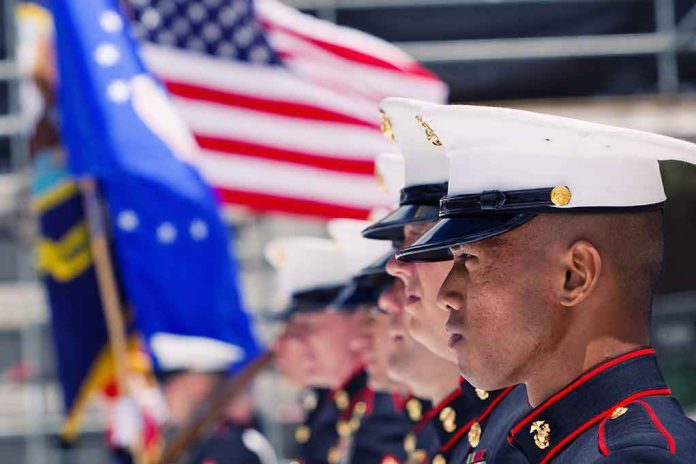
After years of woke distractions and recruitment shortfalls, America’s armed forces have just posted their strongest enlistment numbers in 15 years, with every single active-duty branch beating its goals.
Story Snapshot
- All five active-duty branches met or exceeded fiscal 2025 recruiting goals, the best performance in 15 years.
- The Army, Navy, Air Force, Marine Corps, and Space Force collectively reached about 103% of their active-duty mission.
- Momentum is carrying into 2026, with the Army already meeting its full-year recruiting goal months ahead of schedule.
- Stronger pay, a renewed warrior ethos, and frustration with directionless culture are drawing more young Americans to serve.
Trump-era recruiting surge hits 15-year high
The Department of Defense reports that fiscal year 2025 brought the strongest recruiting performance in 15 years, with every active-duty service meeting or exceeding its goal. The Army set a target of 61,000 recruits and brought in 62,050 new soldiers. The Navy aimed for 40,600 and signed 44,096 sailors. The Air Force recruited 30,166 airmen against a goal of 30,100, and the Space Force brought in 819 Guardians after targeting 796. The Marine Corps hit its goal exactly with 26,600 recruits.
Across the five branches, active-duty accessions averaged about 103% of their combined mission, a level not seen in more than a decade. Pentagon spokesman Sean Parnell said recruiting percentages since November 2024 are the highest in over 15 years, marking a sharp break from the well-known shortfalls earlier in the decade. Those misses included steep gaps for the Army in 2022 and 2023, which had raised real concern about the all-volunteer force’s future. Today’s surge shows that concern has turned into renewed enlistment energy.
Branch-by-branch: who is signing up to serve
Army leaders say the turnaround is especially striking for their service. After years of coming up short, the Regular Army reached 62,050 recruits in 2025, more than 103% of its updated 60,500 goal. That success has carried into fiscal 2026, where Army officials report more than 61,500 contracts signed four months before the end of the year. This fast start suggests that interest in service under a more assertive, less politically correct Pentagon is not a one-year blip but a growing trend.
The Navy, which struggled to fill ships during earlier recruiting slumps, overshot its 40,600 target by bringing in 44,096 sailors in 2025. The Air Force met its 30,100 goal and slightly exceeded it, while the Space Force and Marine Corps also fully met their smaller but critical missions. Even the Coast Guard, which falls under the Department of Homeland Security in peacetime, has reported very strong recruiting, with some reports saying it reached more than 120% of its 2025 goal. Not every reserve component is fully on track, but the active-duty force is once again filling its ranks.
From crisis to comeback: what changed for recruiting
Only a few years ago, analysts described a recruiting “crisis,” pointing to low birth rates, a tight job market, and growing gaps between military culture and younger Americans. In 2022, the Army missed its goal by about 25%, and it fell short again in 2023, while the Air Force and Navy also struggled. That slump followed decades of gradual decline in enlistment numbers, with total new entry-level troops dropping by almost nine percent between 2014 and 2024. Many on the right saw this as the cost of politicizing the ranks and pushing social experiments over readiness.
GOD BLESS OUR
MILITARY
GOD BLESS AMERICAWatching @FoxNews @AmericaNewsroom
interviewing two U S Thunderbird fighter pilots!
GOD BLESS THEM
Their parents must be
PROUD— GeorgiGirl (@TGLO1105) July 3, 2026
Since 2024, the picture has changed. A Department of Defense review shows services recruited about 12.5% more people in 2024 than in 2023, jumping from roughly 200,000 to 225,000 new recruits. By late 2024, officials already expected to exceed 2025 goals, and those expectations have now been confirmed by the final numbers. Policy experts credit several concrete steps: larger pay raises, bigger bonuses, more recruiters, and programs like the Army’s Future Soldier Preparatory Course, which helps borderline applicants meet fitness and academic standards.
Why more young Americans are choosing the uniform
Behind the numbers are deeper currents that matter to conservative readers. Defense analysts note that pay and benefits rank as the top motivators for many recruits, especially in a shaky economy. But they also point to a cultural shift. Commentators describe a renewed focus on warrior ethos and patriotism, along with reduced emphasis on diversity and equity programs, as helping make service more appealing to young Americans who want discipline and purpose. Public comments from Trump officials stress that the military is refocusing on winning wars, not pushing ideological agendas.
At the same time, years of frustration with chaos at the border, rising crime, and global instability have reminded many families why a strong military matters. Reports highlight that today’s recruits are stepping into a force that is demanding but respected, with clearer expectations and less tolerance for political messaging inside the ranks. For parents who worried that the services were drifting away from traditional values, these trends suggest a course correction. The fact that more young people are willing to raise their right hand is one sign that this correction is taking hold.
Big recruiting numbers still need real readiness
While the surge is real, experts caution that strong accessions are only one part of readiness. A recent review found no single, department-wide metric for how long it takes recruits to become fully mission ready after they sign a contract. Training timelines vary widely, from a few months in some support roles to several years for highly technical or special operations paths. Navy officials say it is less about a set timeline and more about proving that a sailor can do the job, which means leaders must keep standards high as class sizes grow.
For constitutional conservatives, the bottom line is clear. A thriving all-volunteer force reduces pressure for any kind of draft, protects the nation in a dangerous world, and gives young Americans a path built on merit, not identity politics. The numbers out of 2025 and the early 2026 Army data show that when Washington prioritizes mission, rewards service, and dials down the culture wars inside the ranks, Americans still answer the call in record numbers.
Sources:
facebook.com, washingtontimes.com, militarytimes.com, war.gov, army.mil, youtube.com, instagram.com, pmc.ncbi.nlm.nih.gov, usamm.com, usafacts.org