

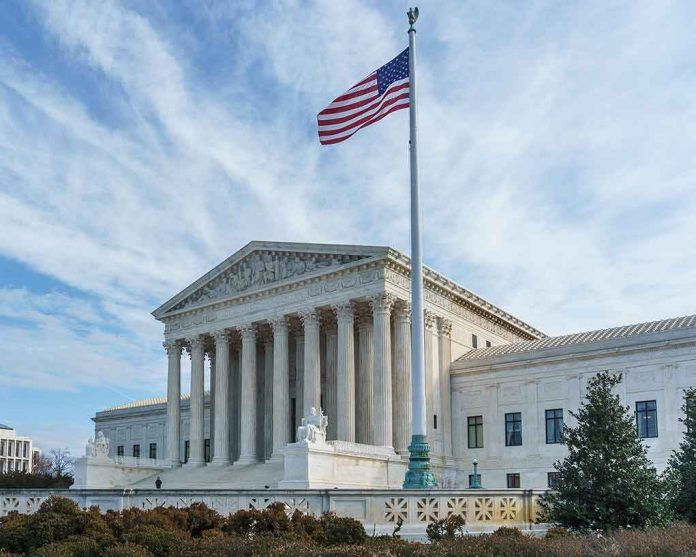
The Trump administration has asked the Supreme Court to let border wall building resume in Texas’s Big Bend region after a federal judge froze all work there.
Story Snapshot
- On Wednesday, October 21, the Justice Department filed an emergency request asking the Supreme Court to lift a judge’s freeze on Big Bend border construction.
- The judge found that two Homeland Security secretaries likely went beyond their legal power when they waived environmental and other laws to speed up the work.
- The government says the freeze hurts its ability to stop illegal crossings and drug smuggling.
- The groups that sued say the region’s rugged canyons already act as a natural barrier.
- The government says the work stoppage costs more than $460,000 a day.
What the Trump Administration Is Asking the Supreme Court to Do
The government wants the justices to pause a lower-court order so crews can go back to work while the lawsuit plays out. The request was written by Solicitor General D. John Sauer, the government’s top lawyer before the Supreme Court. He wrote that the order “significantly frustrates the government’s ability to stop the flow of illegal aliens” across the border.
The filing calls the judge’s order “baseless” and “unprecedented.” It also asks the justices to take up the case and reverse the order outright. The government says the area was picked because of high rates of illegal crossings and drug smuggling. It says more than 89,000 people were caught in the sector from 2021 to 2025, and that the work stoppage costs more than $460,000 a day. It also warns that a gap in Big Bend would become a “funnel point” for crossings and smuggling.
Why the Judge Froze the Work
U.S. District Judge Kathleen Cardone ordered the stop on October 2. Her order bars barriers, related infrastructure and “any construction or ground disturbing activities” across the Big Bend Sector while the case goes on. The sector covers more than 500 miles of the border and 77 Texas counties. On Tuesday, October 20, she turned down the government’s request to put her order on hold, and the government then went to the Supreme Court.
The fight is over waivers. A 1996 immigration law lets the Homeland Security secretary set aside other laws, such as environmental and historic-preservation rules, to build border barriers and roads quickly in areas of “high illegal entry.” Former Secretary Kristi Noem issued a waiver for Big Bend in February. Markwayne Mullin, who replaced her as secretary, issued two more.
In a written opinion on October 14, Cardone said the groups that sued were likely to win their claim that the secretaries did not have the power to issue these waivers. She relied on the “major questions doctrine,” a rule that courts expect Congress to speak clearly before it hands an agency power over matters of huge national weight. She pointed to evidence that Big Bend has the lowest rate of illegal entry on the southern border and concluded that Congress could not have clearly approved the waivers there.
The Government’s Legal Answer
The 1996 law allows court challenges to a waiver only when someone claims the Constitution was violated. The government argues that a claim that a secretary went beyond the law is not a constitutional claim, so the judge had no power to hear it. Sauer also wrote that even if the case raises a major question, Congress “did clearly authorize the Secretary both to build border barriers and to waive legal requirements in order to facilitate their expeditious construction.”
The plan includes 30-foot steel bollard walls, patrol roads, detection technology and about 17 miles of vehicle barriers. According to the government, walls and roads would run more than 300 miles. Customs and Border Protection says the wall will not cut through Big Bend National Park, though roads and other equipment would go there.
What the Challengers Say
The lawsuit was filed in April by an environmental nonprofit, a river guide and a group formed to preserve a local church. They say Big Bend ranks last of the seven southern border sectors for arrests. It covers more than a quarter of the border but accounted for only 0.3% to 2.2% of border-wide arrests, according to court filings.
Zeynep Graves, a senior attorney for the Center for Biological Diversity, one of the groups that sued, said, “We’re deeply disappointed that the Trump administration is asking the Supreme Court for a green light” to bulldoze the landscape. “Once Big Bend’s canyons, cultural treasures and wild ecosystems are destroyed, they’ll be lost forever,” she said. Local voices have pushed back as well. Terrell County Sheriff Thaddeus Cleveland has said the rugged land already does the job: “We’ve got a God-made barrier.”
What Comes Next
The Supreme Court will not decide the whole case at this stage. It will decide only whether the freeze stays in place while the lawsuit moves forward. The Court has not said when it will act. Until it does, Judge Cardone’s order stands and construction in the sector stays on hold.
If the justices grant the request, crews could restart work across the sector while the case is argued. If they deny it, the freeze continues, and the waiver fight goes back to the lower courts.
Sources:
cbsnews.com, scotusblog.com, tpr.org, reuters.com, mrt.com, nbcnews.com