

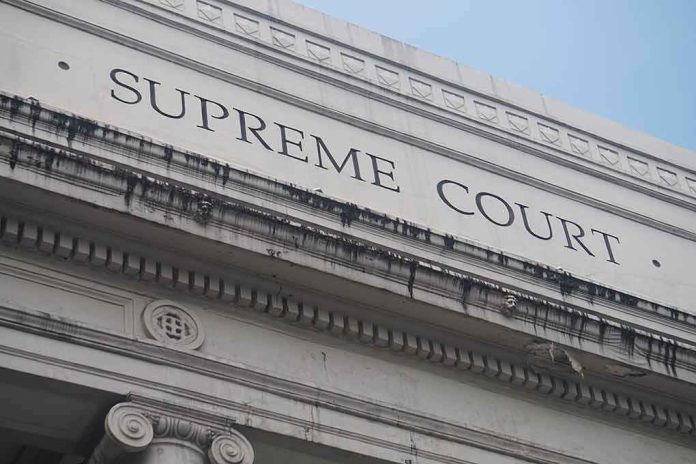
The Trump administration warned the Supreme Court that a judge’s order on Venezuelan deportation protections would inflict “severe and immediate harm,” then withdrew its request after an appeals court froze that order.
Story Snapshot
- On Wednesday, November 18, the Ninth Circuit froze Judge Edward Chen’s order until it rules on the appeal; on Thursday, November 19, the administration withdrew its Supreme Court request, saying it will return to the Court if it loses there.
- The Justice Department filed a third emergency application to halt a Ninth Circuit ruling on Venezuelan Temporary Protected Status (TPS).
- The administration cites a recent Supreme Court decision that limits court review of TPS terminations.
- United States Citizenship and Immigration Services records show the Court once allowed immediate termination of the 2023 Venezuela designation.
- Opponents say Secretary Kristi Noem exceeded legal authority and that harms to Venezuelan families are mounting.
What the New Supreme Court Filing Seeks
On November 18, 2026, the administration filed an emergency application asking the Supreme Court to stay a lower-court judgment that could revive protections for Venezuelan nationals with Temporary Protected Status. The application, titled Markwayne Mullin, Secretary of Homeland Security v. National TPS Alliance, was submitted to Justice Elena Kagan for action. The administration withdrew the request on Thursday, November 19, saying the Ninth Circuit’s freeze made it unnecessary. The request marked the administration’s third emergency appeal in this dispute.
The Solicitor General argued that allowing the lower-court order to take effect would force the Department of Homeland Security to “resurrect” status after a long break, creating serious administrative upheaval. The government warned that rolling back terminations would disrupt removal cases, employment authorization records, and agency operations nationwide. The application asked the Court to pause any restoration while the Ninth Circuit heard the merits of the case.
The Legal Backbone: What the Supreme Court Has Already Said
The administration leans on Mullin v. Doe, a recent Supreme Court ruling. In that decision, the Court held that judges generally cannot review the Secretary of Homeland Security’s core decisions to designate or end Temporary Protected Status for a country. The government says this principle should control here as well. If applied, it would narrow the courts’ role and leave policy choices on country designations to the executive branch.
The administration also points to earlier Supreme Court action that let one termination take effect at once. United States Citizenship and Immigration Services reports that, on October 3, 2025, the Court allowed the end of the 2023 Venezuela TPS designation to take immediate effect. Agency guidance also explains separate timelines tied to the older 2021 designation, which used different document and end-date rules. These records show past high-court deference and the complex, designation-by-designation schedule.
Why the Case Is Still Murky in the Ninth Circuit
Despite the new filing, the litigation remains unsettled. The Ninth Circuit has described the plaintiffs’ case as claiming that Secretary Kristi Noem exceeded legal authority by vacating and terminating Venezuela’s TPS early, before a prior extension expired in 2026. That framing cuts against the administration’s position and keeps live questions about the Secretary’s process and timing choices. The Ninth Circuit’s posture left open the possibility of restoring protections during the appeal.
Advocates also argue that the Department of Homeland Security did not follow normal procedures and that the State Department’s recommendation lacked detailed country analysis. Court descriptions of discovery said regular procedures were not followed in the vacatur and termination sequence. Those claims do not defeat the government’s jurisdiction argument by themselves, but they sharpen the fight over what kinds of claims courts may still review after Mullin v. Doe.
What It Means for Border Security, Rule of Law, and Families
Supporters of the administration say firm rules are needed to secure the border, end “temporary” programs that drift for years, and keep executive discretion where the statute locates it. They view the Supreme Court’s reviewability ruling as confirming that elected leadership, not judges, must decide when a country’s crisis no longer justifies blanket protection. They also stress the real costs of reviving lapsed status after a long pause, including reissuing work permits and restarting large case inventories.
Justice Department Asks Supreme Court to Halt Venezuela TPS Ruling
The Justice Department asked the Supreme Court to stop a ruling reviving Venezuela TPS from taking effect Friday.https://t.co/GgzpREtUSz#Venezuela #VirginiaTimes pic.twitter.com/9AmuIarv5F
— Virginia Times (@newsbreaknow) November 19, 2026
Opponents point to sharp human costs. They cite detentions, family separations from United States citizen children, deportations, and reported deaths tied to the loss of status. They argue that TPS holders have strong work records and low crime rates compared with the general population, undercutting public-safety claims. These claims would not have controlled the Supreme Court’s narrow stay analysis, but they shape public debate while the Ninth Circuit continues the merits case.
Bottom Line: A Freeze, and a Promise to Return
Here is the short version. The administration had asked the Supreme Court to keep the lower-court order on hold while appeals continue, relying on a fresh high-court precedent that limits judicial review of TPS decisions. Prior Supreme Court action already allowed one Venezuela termination to take immediate effect, and agency records show that result in practice. The Ninth Circuit has flagged unresolved questions about authority and process, so the final word is not in yet.
Sources:
supremecourt.gov, supremecourt.report, uscis.gov, signaldata.org, supremecourtcasetracker.com, scotusblog.com, justice.gov, cdn.ca9.uscourts.gov, law.justia.com, migrationpolicy.org