

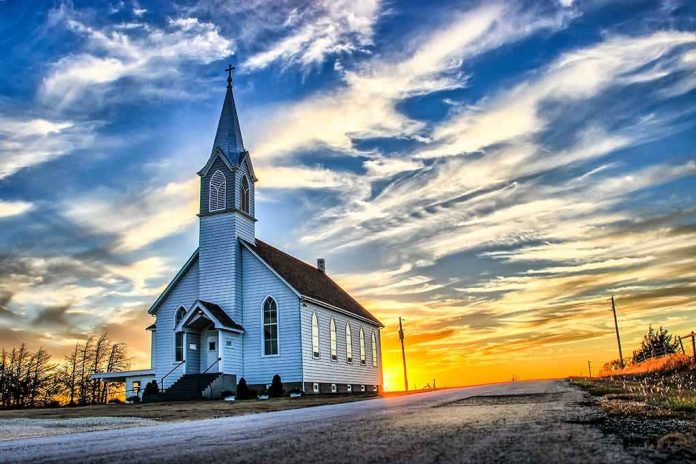
A Kentucky church that was stopped from building a small prayer shrine on its own land will get a hearing at the nation’s highest court. The Supreme Court agreed on Thursday, October 1, to take the case, and the church’s lawyer says the ruling could reach “every single zoning law in this country.”
Story Snapshot
- The church wants to build a 16-by-39-foot grotto, a small cave-like shrine for prayer, on its property in Park Hills, Kentucky.
- A city board approved the plan in April 2021, but two neighbors sued and Kentucky courts stopped it under the town’s zoning rules.
- The justices will decide whether blocking a religious structure on a church’s own land is a “substantial burden” under federal law.
- No date has been set for arguments.
Why the Shrine Was Stopped
The fight is over zoning, the local rules that say what an owner may build on a piece of land and where. Kentucky courts ruled that the city board went beyond its power when it approved the grotto. The church building has stood on the property for nearly a century. That is longer than Park Hills has had its zoning ordinance, which the town adopted in 1974. The Kentucky Court of Appeals treated the shrine as an expansion of a use that came before the zoning rules, and it said the ordinance does not allow that.
SCOTUS takes KY church prayer-grotto case — could reshape zoning for religious liberty.https://t.co/VeKIMX1RpG#SCOTUS #ReligiousLiberty #AltasWorldNews pic.twitter.com/3g6PmPwKOB
— Altas World News (@Altas_WorldNewS) October 2, 2026
The plan began in March 2021, when the Missionaries of St. John the Baptist, a Catholic group, asked the city for a permit. A grotto is a small shrine made to look like a natural cave, and it usually holds a religious statue. This one would honor the Virgin Mary’s appearance to Saint Bernadette in Lourdes, France. It would cover about 600 square feet, close to the size of a swimming pool, with a plaza, a walking path and a retaining wall.
How the Case Reached Washington
The Park Hills Board of Adjustment approved a conditional-use permit and a variance in April 2021. A variance is permission to depart from a zoning rule. Two neighbors, Joel and Elizabeth Frederic, objected and took the board’s decision to state court. A trial court sided with the church. The Kentucky Court of Appeals reversed, and the Kentucky Supreme Court upheld that ruling in December 2025, finding no violation of federal law. The neighbors’ attorney did not respond to a request for comment, according to reports.
The church then asked the Supreme Court to step in. Its claim rests on the Religious Land Use and Institutionalized Persons Act, known as RLUIPA. That federal law protects religious groups from certain burdens on the use of their property. The justices will decide whether a town places a “substantial burden” on religion when it bars a religious structure on land the church already owns.
Why Property Owners Are Watching
Ryan Gardner is senior counsel at First Liberty Institute, the legal group representing the church. He said the stakes go far past one Kentucky town. “This is a massive case for religious liberty because it has the potential to impact every single zoning law in this country,” Gardner said. He added, “RLUIPA is at the intersection of two very critical rights in this country: the rights of religious liberty and property rights.”
For a property owner, the dispute is easy to follow. A city board said yes to a small structure on private land. Two neighbors went to court, and the project has been stalled for more than five years. Towns across the country use zoning boards, permits and variances the same way Park Hills does. A ruling on how much weight federal law gives a church’s plans for its own land would guide those boards and the courts that review them.
What Comes Next
The Supreme Court has not set a date for arguments. The church says the zoning rules keep it from using its own land for prayer. The neighbors won in the Kentucky courts. A ruling is expected later in the court’s term. Until then, the grotto stays unbuilt.
Sources:
foxnews.com, catholicworldreport.com, linknky.com, supremecourt.gov