

Japan’s new F-35B “carrier” decks can now take vertical landings — but the heat is so intense crews must carefully time each landing so the steel does not start to fail.
Story Snapshot
- Japan has turned its Izumo-class helicopter destroyers into light carriers able to host F-35B jets.
- Special heat-resistant coatings and structural changes were needed because vertical landings can warp or crack normal decks.
- Engineers still limit hover time and space out landings so the deck can cool and keep its strength.
- The project shows how much work it now takes for any government to match advanced weapons with real-world operations.
Japan Revives Carrier Aviation with F-35B-Capable Warships
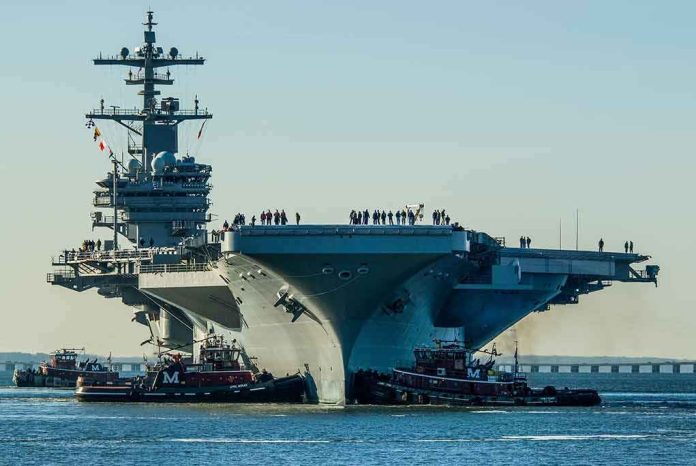
Japan Maritime Self-Defense Force leaders chose to restore fixed-wing carrier aviation by converting the Izumo-class helicopter destroyers to operate the F-35B, the short takeoff and vertical landing version of the Lightning II. JS Izumo, Japan’s largest warship, received deck changes, lighting, and other upgrades so jets could land and take off from her flight deck. This marked Japan’s first true carrier-style air operations since World War II and signaled a major shift in regional naval power.
On October 3, 2021, two United States Marine Corps F-35B jets landed and took off from Izumo, proving the deck could support vertical operations in practice. Japan’s Ministry of Defense described this as a “verification” event, not full deployment, showing the trials were only one step in a longer test process. The flights restored the image of Japanese fighters operating from a carrier deck, but also raised hard questions about how often such landings could safely occur under real combat tempo.
JS Kaga (DDH-184 / CVM-184) is an Izumo-class multi-role cruiser operated by the Japan Maritime Self-Defense Force. Originally commissioned in 2017 as a "helicopter destroyer," the vessel has undergone historic structural modifications to operate fixed-wing F-35B stealth fighters pic.twitter.com/I7GywkQWCx
— Boneyard Safari (@Boneyardsafari) July 24, 2026
Extreme Engine Heat Forces Deck Redesign and Operating Limits
Vertical landings by the F-35B blast the surface below with exhaust hot enough to damage normal concrete and steel. United States and Japanese engineers found that unmodified ship decks could warp or deform from repeated landings, threatening the ship’s structure and long-term safety. In response, Izumo’s flight deck received new heat-resistant coatings and other changes designed to survive the intense thermal load of short takeoff and vertical landing operations. These coatings give the deck a higher temperature limit than standard non-skid paint used on older carriers.
Despite these upgrades, engineers still have to treat each vertical landing as a major heat event for the ship. United States Naval Sea Systems Command experts supporting F-35B sea trials on JS Kaga explained that they time hover duration and space out landings to let the deck cool down. If they do not, heat can build up inside the deck structure and threaten its integrity, forcing costly repairs or even limiting operations. This means the ships can host the jet, but must manage every landing carefully instead of treating the deck as a simple “anytime” runway.
Izumo and Kaga Sea Trials Show Progress and Remaining Challenges
After Izumo’s initial trials, Japan extended the concept to her sister ship, JS Kaga, which has now begun its own F-35B test program. United States Navy reports describe a specially instrumented F-35B landing on Kaga to gather detailed data on deck heating, noise, and other stresses over time. This information helps both navies refine where jets can hover, how long they can stay in vertical mode, and what maintenance the deck will need across many years of operations.
Defense analysts say these changes effectively turn the Izumo-class into light aircraft carriers that can project airpower away from vulnerable land bases, a shift watched closely by China and other regional powers. At the same time, the need for heat-resistant coatings, landing intervals, and strict timing rules underlines a broader reality: modern weapons often arrive before infrastructure and procedures are ready to support them. For citizens worried that governments chase high-tech hardware without fixing basic systems, Japan’s F-35B decks offer a clear, steel-and-heat example of that deeper problem.
Sources:
19fortyfive.com, youtube.com, navy.mil, aerotime.aero, mod.go.jp, stripes.com, theaviationist.com, news.usni.org, cpf.navy.mil