

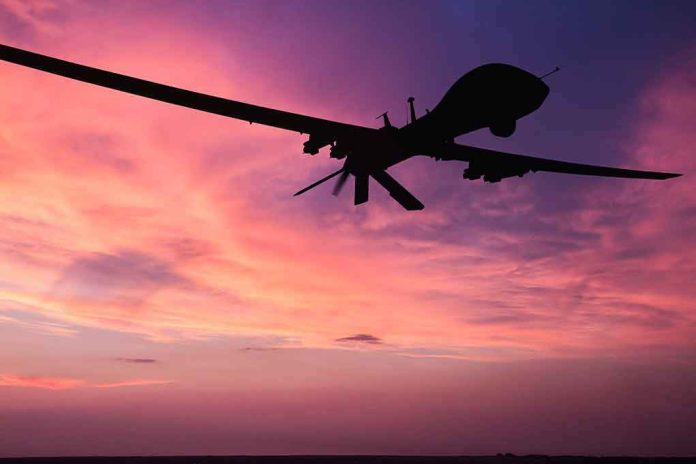
U.S. forces shot down two Iranian attack drones fired toward Bahrain, and the U.S. military flatly rejected Iran’s claim that it had destroyed an American radar there.
Story Highlights
- U.S. Central Command said two Iranian “one-way attack drones” launched toward Bahrain were both shot down, with “no injuries or damage.”
- Iran’s Revolutionary Guards claimed they destroyed a U.S. early-warning radar in Bahrain. Central Command called that a false claim.
- The Guards said they struck in answer to an air attack on a telecommunications tower in Sirik, a town on Iran’s southern coast.
- Iran’s claim of a hit could not be independently verified, according to reports.
- Bahrain is home to the U.S. Navy’s Fifth Fleet, which patrols the Gulf and nearby waters.
What CENTCOM Says Happened
On Friday, November 13, U.S. Central Command, known as CENTCOM, which runs American military operations in the Middle East, posted on X: “The IRGC launched two one-way attack drones toward Bahrain and both were shot down by U.S. forces. There were no injuries or damage.” The IRGC is Iran’s Islamic Revolutionary Guard Corps, the country’s most powerful military force. A one-way attack drone is an unmanned aircraft loaded with explosives and built to crash into its target rather than fly home. The Guards said the target was an American radar and called the strike payback for an air attack on a telecommunications tower in southern Iran.
CENTCOM’s post came hours after the Guards announced their strike, and it answered them directly, labeling Iran’s account a “claim” and its own a “fact.” Bahrain is a small island kingdom in the Persian Gulf and home to the headquarters of the U.S. Navy’s Fifth Fleet, which patrols the Gulf and nearby waters. It was the first Iranian claim of an attack on American military assets in a Gulf country since early September, according to reports.
What Iran Claims, and Why
The Guards said their Aerospace Force “targeted and destroyed” a U.S. early-warning radar in Bahrain. An early-warning radar is a long-range radar that spots incoming missiles and aircraft early, so defenses have time to react. The Guards said the strike answered an air attack on Thursday, November 12, on a telecommunications tower in Sirik, a town on Iran’s southern coast along the Strait of Hormuz. They did not name who carried out that attack, and Iran’s official news agency gave no details of damage. Sirik hosts part of Iran’s radar and communications network and has been hit several times during the war.
The Guards called their strike “a serious warning” to Washington “to put an end to its aerial provocations and oil smuggling in the Strait of Hormuz.” They said their forces were on “full alert and ready to respond without geographical limits” if “such violations and acts of aggression” happen again. Iran’s claim of destroying the radar could not be independently verified, according to reports, and CENTCOM said nothing was damaged.
The Wider Fight Behind the Drones
The clash comes in a war that began with U.S. and Israeli strikes on Iran on February 28. Since then, Iran has fired on U.S. facilities in Bahrain and elsewhere in the Gulf. The United States has kept a naval blockade on Iranian ports since April, and CENTCOM said on Wednesday, November 11, that its forces were working “around the clock keeping the Strait of Hormuz open for commercial shipping.” The strait is the narrow sea lane at the mouth of the Persian Gulf that carries a large share of the world’s oil. On Thursday, November 12, Iran’s army said two oil tankers caught fire after hitting naval mines in the eastern part of the strait.
Hopes for a deal have dimmed. On Thursday, November 12, President Trump wrote on Truth Social, “We don’t need a deal with Iran. Those days have long since passed.” He also asked Vice President JD Vance, who had led U.S. efforts toward a cease-fire and new nuclear talks, to focus on issues at home. Iran says formal talks cannot resume until the United States ends the blockade, releases frozen Iranian money and stops the fighting on all fronts.
Why This Matters at Home
The drones were headed for the island that serves as home base for a major U.S. Navy command, and the Guards said their aim was American equipment. By CENTCOM’s account, U.S. defenses stopped both drones before they could do harm, and no one was hurt. That is the job those defenses are there to do: meet a threat early and keep American forces and allies safe.
Iran’s leaders have warned that the fight could spread. Days before the drones flew, Iranian security chief Mohsen Rezaei said U.S. bases in Europe could be targeted if American aircraft attack Iran from them. The Guards’ promise to respond “without geographical limits” points the same way. For American families with loved ones serving overseas, every drone shot down over the Gulf is one that never reaches its target.
Sources:
insiderpaper.com, apnews.com, reuters.com, u.aa.com.tr, rferl.org, tribuneindia.com