

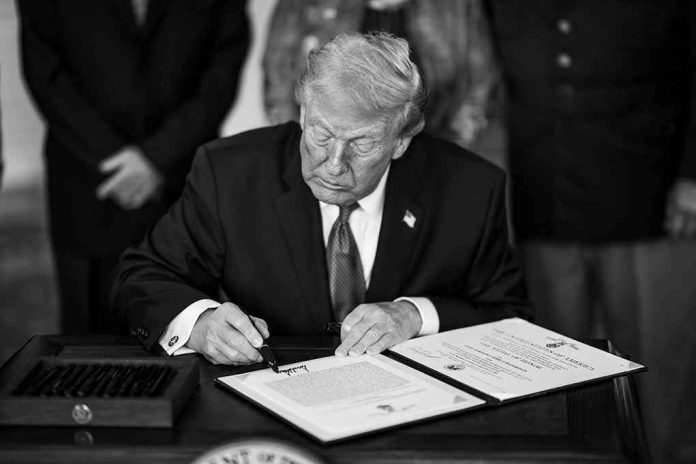
President Trump signed the Common Cents Act, which writes the end of the penny into law a year after the Mint made its last circulating penny, and lets stores round cash totals to the nearest nickel.
Story Highlights
- President Trump signed H.R. 10167, the Common Cents Act, on Friday, November 20, 2026.
- The Mint already stopped making circulating pennies in November 2025; the law makes that stop permanent, keeps pennies legal to spend and allows collector coins.
- Rounding applies to cash only. Card, check and other electronic payments are unchanged.
- The Mint says a penny cost 3.02 cents to make and distribute in fiscal 2025.
Trump Signs Law To Stop Circulating Pennies
On Friday, November 20, 2026, President Trump signed H.R. 10167, the Common Cents Act, into law. The White House said the law directs the Department of the Treasury to stop making pennies, except for collectors, and gives rounding guidance for cash purchases. The Mint had already made its last circulating penny on November 12, 2025, according to reports; the new law makes that stop permanent and sets the rules for rounding cash totals. The law also lets nickels be made from cheaper materials. A nickel cost 13.31 cents to make in fiscal 2025, reports say.
Why The Penny Ended: Cost
The penny costs more to make than it is worth. Mint figures show it cost 3.02 cents to make and distribute each penny in fiscal 2025, down from 3.69 cents the year before. The Treasury estimates that ending production will save about $56 million a year in material costs. The White House has called the move the end of a recurring loss for taxpayers.
Congress has debated this for decades. A House report says efforts to end the penny go back to the 1980s and came from both parties, driven by rising costs and the penny’s fading buying power. In the House, Rep. Lisa McClain, a Michigan Republican, introduced the bill. Sens. Cynthia Lummis, a Wyoming Republican, and Kirsten Gillibrand, a New York Democrat, led a similar Senate effort.
What Changes At The Register
The rounding rules apply only when you pay with cash. Card, check, electronic transfer, gift card and money order payments are unaffected and still charge the exact amount.
Rounding is optional for businesses. A store with enough pennies can still give exact change. Totals ending in 1, 2, 6 or 7 cents may be rounded down to the nearest nickel. Totals ending in 3, 4, 8 or 9 cents may be rounded up. For example, $18.67 may become $18.65, and $24.38 may become $24.40. A store may round the full total, including tax, or the change owed. Rounding in the customer’s favor is always allowed.
What It Means For Your Pennies
Pennies you already have stay legal tender, so you can keep spending them. The law lets the Mint keep making pennies for collectors. Reports on other countries that dropped small coins, such as Australia and New Zealand, found no noticeable effect on inflation.
Sources:
coinnews.net, whitehouse.gov, congress.gov, whitehouse.gov, sencanada.ca