

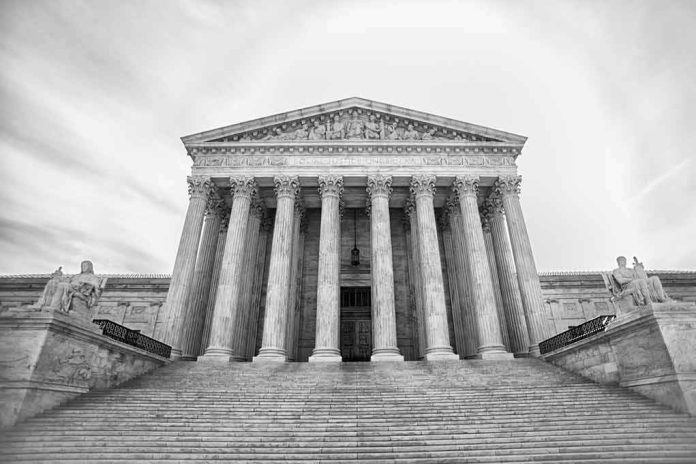
The Supreme Court refused to hear gun owners’ challenge to Maryland’s bans on carrying guns in parks, bars, hospitals, stadiums and government buildings, so those places stay off-limits.
Story Highlights
- The justices turned away the case, Novotny v. Moore, without deciding whether Maryland’s law is constitutional.
- That leaves in force an appeals court ruling that upheld every “sensitive place” ban the gun owners challenged.
- Justice Clarence Thomas said he doubts the Second Amendment allows so many bans, but agreed this case was too sweeping to review.
- Maryland says history supports keeping guns out of confined and crowded places.
The Court Turns the Case Away
On Monday, November 16, the Supreme Court declined to hear a challenge to Maryland’s laws that ban guns in what the state calls “sensitive places.” The challengers were gun-owning Maryland residents and gun rights groups. They argued the bans break the Second Amendment. By refusing their appeal, the Court left in place a ruling by the Fourth Circuit, the federal appeals court that covers Maryland. That court upheld all of the challenged bans on sensitive places.
Turning a case away is not the same as agreeing with the lower court. The justices did not rule on whether the bans are lawful. They simply chose not to take up this case, and no justice dissented.
Justice Clarence Thomas explained why he went along. He said he is skeptical that the Second Amendment lets Maryland ban guns in so many places. But he said the challenge was so broad that it “would complicate our review.” He added, “In an appropriate and more narrowly focused case, however, we should consider the scope of States’ authority to ban firearms.”
Where Guns Stay Banned
The appeals court ruled on January 20, 2026. It upheld Maryland’s carry bans in government buildings, mass transit, schools and school grounds, state parks and forests, museums, health care facilities, and sports and entertainment venues such as stadiums. It also upheld bans in places that serve alcohol and within 1,000 feet of a public demonstration. The state’s list of off-limits places also includes child care centers, polling places, college buildings, power plants, casinos and amusement parks.
The appeals court did strike down one separate rule, which is not on the sensitive-places list. Maryland had banned carrying on private property open to the public, such as a store, unless the owner said yes. The court said that rule went too far. In a separate case, the Supreme Court struck down a similar Hawaii law.
The appeals court had put its ruling on hold while the challengers asked the Supreme Court to step in. During that pause, state police guidance listed the bans on bars and near protests as not being enforced. Gun owners can check the Maryland State Police list of prohibited places for the current rules.
Why Maryland Passed the Law
Maryland added many of these bans in 2023, and Gov. Wes Moore signed them. The law came a year after a 2022 Supreme Court case called New York State Rifle & Pistol Association v. Bruen. That ruling said for the first time that the Second Amendment protects carrying a gun outside the home. It also set a new test: a gun law must fit the nation’s history of gun rules. The Court said some places, such as schools and courthouses, can be “sensitive places” where guns are banned. It did not spell out how far that list can go.
Maryland Attorney General Anthony Brown argued the bans pass that test. He said there is a “rich American tradition” of barring guns in places that are “confined and crowded.” When the appeals court ruled, Moore called it “a major win for public safety in Maryland.”
What Gun Rights Groups Say
The challengers sued the same day the law was signed. They told the Supreme Court that these bans are “among the most critical questions facing the judiciary” since Bruen. They called the lower court rulings “an incoherent morass.” Adam Kraut, who runs the Second Amendment Foundation, said of the state’s carry permits, “Maryland simply made those permits useless everywhere.”
The challengers noted that more states are passing their own lists of gun-free places. Thomas’s statement signals that at least one justice wants a narrower case on the question. The Court will hear arguments in December on whether bans on assault-style rifles are constitutional.
Sources:
cbsnews.com, marylandmatters.org, mdsp.maryland.gov, supremecourt.gov, supremecourt.gov, governor.maryland.gov