

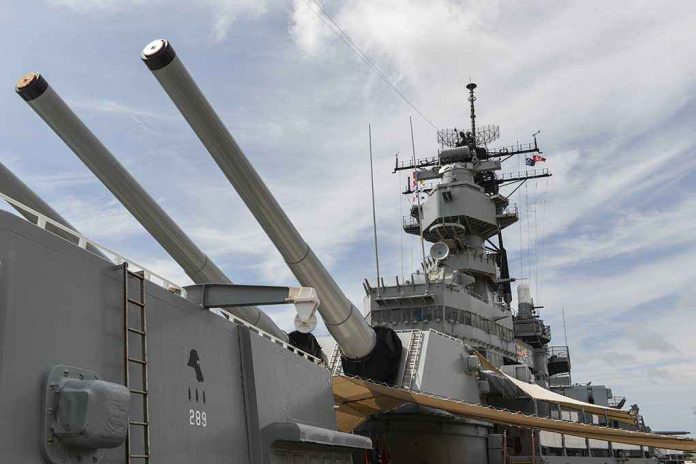
Iraqi soldiers on Kuwait’s Faylaka Island once surrendered to a pilotless plane from the battleship USS Wisconsin, the oddest moment in a sea-borne bluff that helped win the 1991 Gulf War.
Story Highlights
- Iraqi troops on Faylaka Island waved makeshift white flags at a Pioneer drone launched from USS Wisconsin, the first time soldiers gave up to an unmanned aircraft.
- Marines later went out and collected the men who surrendered.
- The battleships Wisconsin and Missouri helped sell a fake beach landing that kept Iraqi units watching the sea while the main attack came from the desert to the west.
- Iraq fired two Silkworm missiles at Missouri; neither hit her.
- Between them, the two ships fired 1,083 16-inch shells and 52 Tomahawk cruise missiles.
Desert Storm, the U.S.-led campaign to drive Iraq’s army out of Kuwait, ran from Thursday, Jan. 17, 1991, to Feb. 28, 1991. The battleships had a clear purpose in it: make Saddam Hussein’s commanders believe Marines were about to storm the Kuwaiti coast, so they would keep troops on the beaches instead of sending them to meet the real attack.
A Surrender to a Flying Camera
The Pioneer was a small, remote-controlled plane that carried a camera. From high above, it spotted targets for the battleships’ huge 16-inch guns and showed the crews where their shells landed. Wisconsin’s Pioneer flew 348 hours during her eight months in the Persian Gulf.
Missouri had already shelled Faylaka Island, off the coast near Kuwait City. When Wisconsin sent her drone over the Iraqi positions ahead of another barrage, Iraqi soldiers looked up and waved makeshift white flags to signal they were giving up. Marines later collected them. That very drone is part of the Smithsonian’s collection.
Selling a Landing That Never Came
Planners wanted Iraq to expect a landing from the sea, including on Faylaka Island. That would pull Iraqi forces toward the Persian Gulf and away from the southwest, where coalition tanks were massing. The battleships’ steady shelling of the shore made the threat feel real, and it was terrifying for the Iraqi troops dug in along the coast.
When the ground war opened, Missouri moved within about ten miles of the Kuwaiti coast, guarded by the U.S. destroyer Jarrett and the British destroyer HMS Gloucester. On Feb. 25, 1991, ten Marine helicopters flew a night feint, a fake move meant to look like an attack, near the coastal town of Ash Shuaybah, with Missouri’s guns firing in support. By some counts, Iraq kept as many as six divisions manning its coastal defenses, waiting for Marines who never came ashore.
Iraq Fires Back
The feint worked well enough to draw a response. Iraqi forces fired two Silkworm missiles, Chinese-made anti-ship missiles, at Missouri. The first was thrown off by chaff, clouds of metal strips that ships fire to confuse incoming missiles, and it fell into the sea between Missouri and Jarrett. HMS Gloucester shot down the second with two Sea Dart missiles. An American E-2C Hawkeye radar plane then found the launch site, and the site was attacked.
There was a dangerous mix-up, too. Jarrett’s Phalanx, a rapid-fire gun that shoots down incoming missiles on its own, reportedly locked onto Missouri’s chaff cloud. Some of its 20mm rounds struck Missouri from more than two miles away. One person was hurt, and no one was killed.
The Big Guns Speak Again
Wisconsin’s first gunfire mission of the war came on Feb. 6, 1991. She sent 11 16-inch shells more than 20 miles at an Iraqi artillery position in southern Kuwait. It was her first gunfire in support of troops since 1952, in the Korean War. A Marine OV-10 Bronco, a small twin-engine plane used to spot targets, helped guide the fire.
By the end, Missouri had fired 759 16-inch shells and 28 Tomahawks, long-range guided missiles launched from ships. Wisconsin fired 324 16-inch shells, 881 5-inch rounds, 5,200 rounds from her Phalanx guns and 24 Tomahawks. Two ships first launched in World War II proved they could still shape a modern battle, and even take a surrender from the sky.
Sources:
jalopnik.com, usmcu.edu, history.navy.mil, wearethemighty.com