

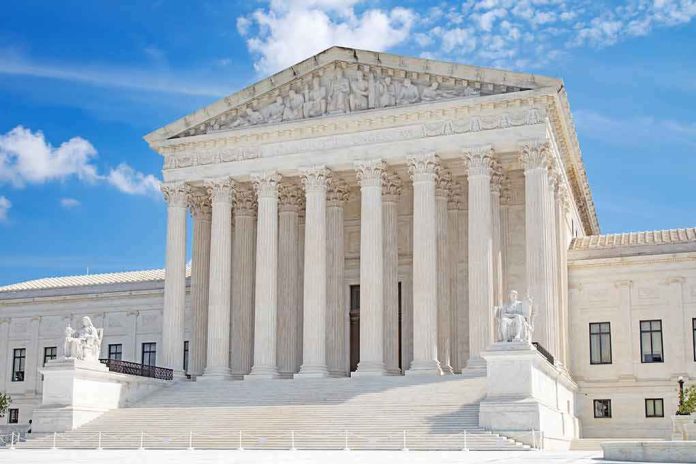
The Supreme Court threw out a $28 million Roundup cancer verdict and sent the case back to a California court for another look.
Story Highlights
- The Court set aside the $28 million judgment won by Mike Dennis, a California man who blamed Roundup for his cancer.
- A California appeals court must now review the case again in light of the Court’s June ruling for Roundup maker Monsanto.
- That June ruling says federal law blocks state lawsuits claiming Monsanto should have put a cancer warning on the label.
- The Court did not rule that Roundup is safe; it ruled on who controls the label.
What the Court Did
The Court’s order was short. It agreed to take Monsanto’s appeal, wiped out the California judgment and sent the case back to the state appeals court in San Diego. That court must now look at the case again with the June ruling in mind. In legal terms, the judgment was “vacated,” which means canceled, and “remanded,” which means sent back to a lower court.
The order came on Tuesday, October 13, on the Court’s list of orders for the new term. Monsanto is now owned by the German company Bayer.
Who Mike Dennis Is
Dennis is a Carlsbad, California, man who said he used Roundup for decades. In 2020, he was diagnosed with a rare form of non-Hodgkin lymphoma, a cancer of the immune system. His treatment put the cancer into remission, but there is no cure, and his doctors have said it may return.
In 2023, a San Diego jury awarded him $332 million. That included $325 million in punitive damages, which are meant to punish a company rather than repay the person who was hurt. The jury found that Monsanto failed to warn about Roundup’s risks, but sided with the company on claims about the product’s design. In February 2024, a judge cut the total to $28 million. A state appeals court later upheld that amount.
Why the June Ruling Matters
On June 25, the Supreme Court ruled 7-2 in a different Roundup case, Monsanto v. Durnell. The Court said a federal pesticide law requires one national label for weed killers, approved by the Environmental Protection Agency, or EPA. States cannot force a company to add a warning the EPA has not approved. “Monsanto legally must use a label without a cancer warning unless and until EPA approves or requires a change,” Justice Brett Kavanaugh wrote for the majority.
Justice Ketanji Brown Jackson, joined by Justice Neil Gorsuch, dissented. She called the ruling “both remarkable and regrettable.” Because Dennis won on a failure-to-warn claim, which says a company did not tell buyers about a danger, his award now has to be weighed against that ruling.
What It Means for Your Garage Shelf
Roundup’s label stays the same nationwide. The EPA has repeatedly said glyphosate, the main ingredient, is not likely to cause cancer when used as directed. A World Health Organization research agency called it “probably carcinogenic to humans,” meaning it probably can cause cancer, in 2015. The Supreme Court did not settle that science. It only decided that the EPA, not state juries, sets the label.
If you use weed killer, follow the label, wear gloves and store it out of reach of children and pets. If you have health worries about past use or any symptoms, talk with your doctor. Many conditions, some of them serious, can look alike, and only a doctor can sort them out. This article is not a substitute for medical care.
What It Means for Others Who Sued
Thousands of Roundup lawsuits remain pending, according to Monsanto. Claims that rest only on a missing cancer warning now face the June ruling. Each case will be decided by its own court.
Why Conservatives Should Care
One national label means farmers, homeowners and small lawn crews are not caught in a maze of 50 different state rules. It also keeps the experts at the EPA, not a jury in one county, in charge of what a label says. That is the kind of clear line that keeps prices steady and the law the same in every state.
Sources:
supremecourt.gov, legalnewsline.com, bayer.com