

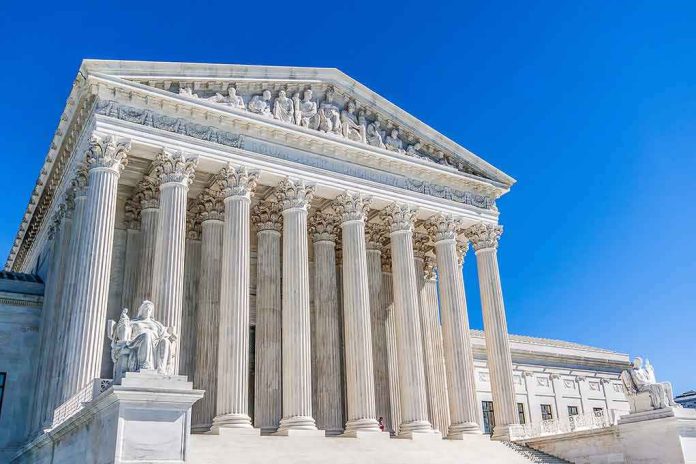
Dylann Roof, the man sentenced to death for shooting nine Black worshipers to death at a Charleston, South Carolina, church in 2015, has lost another appeal at the Supreme Court. On Monday, October 5, the justices turned away his argument that the judge who ran his trial should have stepped aside, a claim built on a remark that another judge reportedly made: the trial judge “really wants to do it.”
Story Highlights
- The Supreme Court declined to hear Roof’s appeal, so the lower court ruling against him stands.
- Roof argued that U.S. District Judge Richard Gergel, who presided over his trial, was biased and should have removed himself.
- A federal appeals court rejected that claim in August 2025, saying it rested on hearsay.
- Roof was convicted of 33 federal counts, and a jury chose a death sentence in January 2017.
Why Roof Wanted His Judge Removed
Roof’s lawyers aimed this appeal at one man: U.S. District Judge Richard Gergel, the federal trial judge in Charleston who has handled the case since the day after Roof was indicted. They said Gergel should have recused himself, which means a judge steps aside from a case because his fairness could reasonably be doubted. Their reason was a secondhand remark. According to the appeal, another judge told an attorney that “Gergel really wants to do it.” Roof’s defense read those words as an eagerness to convict and sentence him that crossed the line into bias.
The Supreme Court did not take up that argument. When the Court declines to hear a case, it issues no ruling of its own on who was right. The decision of the court below simply stays in place. For Roof, that means his convictions and his death sentence are unchanged.
What the Lower Court Said
The claim had already failed once. In August 2025, the Fourth Circuit Court of Appeals, the federal appeals court in Richmond, Virginia, that reviews cases from South Carolina, turned down Roof’s request to take Gergel off the case. The judges said Roof had not shown “a clear and indisputable right” to what he asked for, because his request leaned on hearsay, meaning a statement passed along by someone else instead of sworn, firsthand evidence. The court added that a judge forming a poor opinion of a defendant during a case is not, by itself, a reason to remove him.
This is the second time the Supreme Court has refused Roof. In 2022 the justices declined an earlier appeal, one that centered on his disagreement with his own lawyers over whether to present evidence about his mental health at trial.
The Crime and the Sentence
On June 17, 2015, Roof walked into a Bible study at Emanuel African Methodist Episcopal Church, known as Mother Emanuel, and opened fire. Nine people died. Federal prosecutors said he was driven by racist hatred. In December 2016 a federal jury convicted him of all 33 counts against him, including hate crimes, obstructing the exercise of religion and firearms charges. In January 2017 the same jury chose death after about three hours of deliberation, and Gergel formally imposed the sentence the next day.
Roof is held on federal death row, the unit for federal prisoners sentenced to die, at the prison in Terre Haute, Indiana. For the families of the nine people killed at Mother Emanuel, Monday’s order closes one more path Roof had hoped would undo the verdict.