

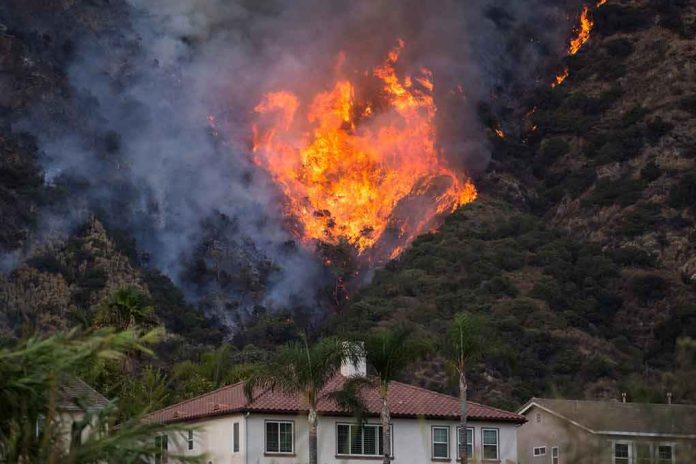
People living closest to where the Palisades fire started got their evacuation alert roughly 40 to 90 minutes after homes were already burning, according to a 724-page report on the January 2025 Los Angeles fires that the state finally released Friday, October 2.
Story Highlights
- Gov. Gavin Newsom ordered the report days after the fires began. It was written by the Fire Safety Research Institute, a nonprofit fire-science group.
- The report says Los Angeles firefighters never went back to check an earlier fire that was still burning underground.
- City police and city firefighters worked from two different evacuation maps for most of the first day.
- The fires killed 31 people and destroyed more than 16,000 homes and buildings. The report makes 266 recommendations.
Why The Warnings Came Late
The report gives two main reasons. First, the Los Angeles Fire Department did not make sure an earlier blaze, called the Lachman fire, was fully out. Second, the agencies fighting the fires were not working from one plan. They had separate commands and separate maps, and key reports never reached the people in charge.
The clock on January 7, 2025, tells the story. At 10:46 a.m., a fire helicopter crew radioed that flames would reach homes “within minutes.” At 11:29 a.m., a Los Angeles Fire Department assistant chief called for an evacuation order. The city sent its first evacuation order at 12:09 p.m.
The Fire That Was Never Checked
The Lachman fire was a small brush fire in the hills above Pacific Palisades. Firefighters contained it on January 1, 2025, six days before the Palisades fire. During the cleanup, firefighters reported seeing “a wisp of smoke.” The department got another report of smoke on January 3 and found none when crews arrived.
After that, the report says, there was no evidence the department went back to patrol the burn area for hot spots, even with dangerous winds in the forecast. A hot spot is a patch of ground that still holds heat and can flare up again when wind hits it. The report found the department had no proper procedure to make sure the fire was out. The Lachman fire later grew into the Palisades fire, which killed 12 people.
Sent Home Before The Wind
The report also faults the city’s staffing. As the windstorm approached, the Los Angeles Fire Department sent its outgoing shift home and added only three extra engines. The report says those choices “did not follow their own written procedures and appeared to be largely budget constraint-driven.”
The Los Angeles County Fire Department, a separate agency that covers areas outside the city, took the opposite approach. It doubled its firefighters on duty from about 1,500 to about 3,000 and put more than 20 extra engines in place.
Once the fire was moving, the city’s response came apart. Police and firefighters used different evacuation maps until late on January 7. As many as 26 fire units went out without the knowledge of incident command, the single team that is supposed to direct everyone at a large emergency. That command post moved three times. The report says the city fire department “lacked experience with large, complicated fires.”
The Same Night In Altadena
The county had its own failure that night in Altadena, where the Eaton fire killed 19 people. All but one of them died in west Altadena. Paramedics there reported embers falling “like snow” and buildings on fire, but that word did not reach the commanders running the fire.
The first evacuation alert for most of west Altadena went out at 3:25 a.m. on January 8. That was more than four hours after the first 911 call from that side of town. The report says county commanders did not know the fire had moved through west Altadena until daylight.
What Officials Said
Los Angeles Mayor Karen Bass, who removed Fire Chief Kristin Crowley weeks after the fires, pointed to changes made since. “That is why I put in place new leadership at the Los Angeles Fire Department,” she said. “Under Chief Jaime Moore, 92% of the recommendations from LAFD’s own internal review have been put in place.”
Newsom said, “We must use these lessons learned to strengthen preparedness and help every community be better equipped to respond to the growing, climate-driven wildfire threat.”
The report itself does not pin the disaster on one person or one choice. It says the destruction “was the result of multiple interconnected factors rather than any single decision, event, or system failure.” For families who lost homes or relatives, the findings are the first full official account of what went wrong, and they hand the city and county a long list of fixes to make before the next windstorm.
Sources:
redstate.com, ground.news, pasadenastarnews.com, latimes.com, laist.com