

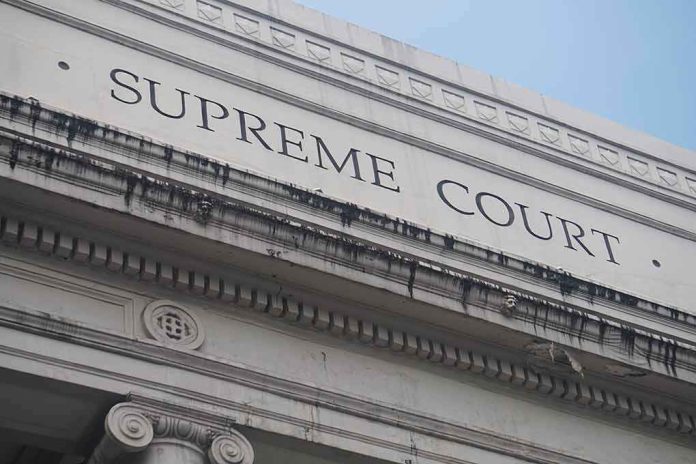
The Supreme Court cleared parts of President Trump’s mail-ballot order to proceed for now, even as new rulings keep swinging the rules days before ballots go out.
Story Snapshot
- The Supreme Court lifted a key block on Trump’s mail-ballot order, but not the final word.
- Judges said the president may have overstepped on state election powers, fueling fresh suits.
- The order tasks the Postal Service with voter-list checks and envelope standards, drawing fire.
- Research and officials cite little proof of widespread mail-voting fraud, raising cost-benefit questions.
What The Supreme Court Did And Did Not Decide
On August 24, the Supreme Court lifted a lower-court order that had blocked parts of President Trump’s executive order on mail ballots in 23 states and Washington, D.C. The unsigned decision allows implementation to move forward while lawsuits continue, but it is not a final ruling on legality. A dissent said the order did not answer whether the executive branch has authority to carry out the directives, underscoring the temporary nature of the relief.
The Justice Department had asked the Court in late July to pause a district court injunction that stopped enforcement across those states. Government lawyers argued that the measures were needed ahead of the midterm elections. The justices’ action narrowed immediate blocks, but it left space for ongoing challenges in lower courts, where judges will weigh statutory limits and constitutional lines on federal and state election roles.
What The Executive Order Would Change In Mail Voting
The executive order directs the United States Postal Service to set rules for ballot mail. That includes requiring states to submit lists of eligible mail voters, reviewing and approving ballot-envelope designs, and refusing ballot mail that does not meet those standards. States and voting-rights groups say this hands federal agencies new power over how ballots move, which they argue Congress has not clearly authorized in law.
Supporters, including House Speaker Mike Johnson, say the plan is basic validation to keep only legal ballots in the mail stream. They frame it as a common-sense way to protect citizen voting and cut errors before ballots reach local officials. Critics respond that late changes add confusion and could stop lawful ballots, including those from military and overseas voters, if lists are incomplete or designs are rejected close to deadlines.
Lower-Court Pushback And Federalism Concerns
Several federal judges have ruled that large parts of the order likely exceed presidential authority. One decision said the Constitution gives Congress and the states, not the president, control over election procedures. That judge also wrote that the United States Postal Service lacks a clear grant from Congress to make binding mail-voting rules. These opinions highlight separation-of-powers issues and raise the risk of last-minute election disruptions if rules keep changing.
After the Supreme Court’s August 24 action, at least one judge revisited an earlier nationwide block. The judge concluded that the high court’s ruling required a narrower approach while litigation continues. This back-and-forth creates a patchwork of rules across states, which can erode trust among both conservatives and liberals who already believe that insiders change the rules to suit political goals rather than to serve voters.
The Evidence Question: Fraud Risk Versus Administrative Error
The administration argues that only citizens can vote in federal elections and that safeguards are needed to enforce that limit. However, election officials and major research reviews report very few proven mail-voting fraud cases in recent years. One analysis noted just under 300 proven absentee-ballot fraud cases over more than four decades and found extremely low fraud rates in 2025, which fuels questions about whether new hurdles fix a real problem or create new ones.
The policy fight now turns on proof and practicality. Courts will ask whether federal agencies have clear legal authority and whether the steps can work at scale without blocking lawful votes. Voters across the spectrum want clean rolls and secure ballots, but they also want their votes counted on time. With deadlines near, even small errors in lists or envelope rules could feed a larger story that the system serves elites, not citizens.
Sources:
redstate.com, reuters.com, cnn.com, thehill.com, cnbc.com