

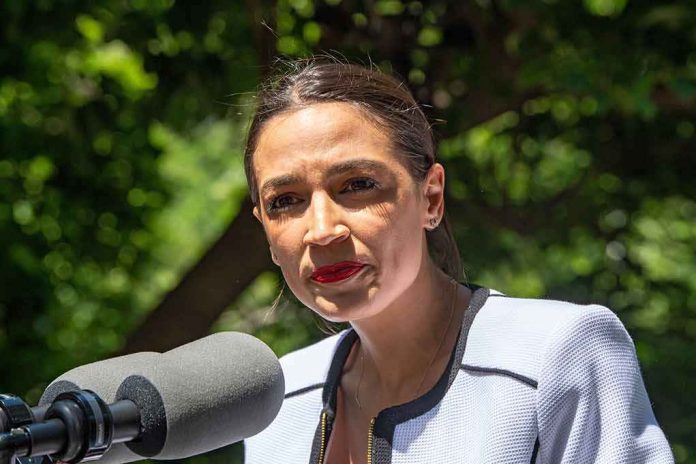
Newsmax host Greg Kelly said Representative Alexandria Ocasio-Cortez’s “looks” got her noticed but that she “can’t produce,” turning a policy fight into a test of substance and media power.
Story Highlights
- Greg Kelly argued AOC’s appeal is image-driven and said she “can’t produce.”
- AOC’s past interviews outline policy goals on health care, education, and climate.
- Research shows women in politics face more appearance-based attacks than men.
- The legal bar for defamation protects sharp media criticism of public figures.
What Kelly Said And Why It Landed
On his Newsmax program, Greg Kelly claimed Representative Alexandria Ocasio-Cortez’s youth and looks helped her gain attention but said those assets “only get you so far” and that she “can’t produce.” The segment framed her as driven by image and performance, not policy depth. The claim taps broad anger at political showmanship across the spectrum. Many Americans think Washington rewards branding over results. Kelly’s framing aims straight at that sore spot, making the swipe stick with frustrated viewers.
Kelly’s take fits a common media tactic: question a politician’s seriousness by tying style to weak output. That tactic can be powerful in a time of high prices and policy fatigue. Viewers see gridlock and hear big promises, then ask, “What changed for me?” The attack suggests the answer is “not much.” But the charge also reduces a sitting lawmaker’s record to a punchline. That invites a test against on-the-record statements and measurable work, not just a viral clip.
What AOC Has Said About Policy And Results
Ocasio-Cortez has stated clear policy goals in major interviews over several years. She has argued for universal health care, tuition-free public college, and large climate investment, setting a left-leaning agenda in simple terms that voters can judge. In a national convention address, she described a movement focused on guaranteed health care, accessible education, higher wages, labor rights, and reformed immigration and foreign policy systems. Those are not slogans alone; they are benchmarks that invite a results scorecard.
On climate and jobs, she has linked recent laws to goals like stronger unions and better worker pay, describing how federal tax credits and investment can steer production and hiring. In a House hearing, she pressed for real rules on artificial intelligence, saying Congress had passed zero dedicated laws, and criticized efforts to block state oversight. Those remarks show a push for concrete guardrails. Voters can still ask if those goals became law, but the record shows policy focus beyond image alone.
The Gendered Pattern And Why It Matters
Scholars and watchdogs have found that women in politics face more comments about looks and age than men, even when both get harsh treatment online. That trend appears across countries and platforms, and it shapes how audiences judge competence. When coverage leans on appearance, it can crowd out discussion of votes, amendments, and negotiations. That does not make all criticism sexist. It does mean style-first attacks risk blurring substance at a time when citizens want solutions that lower bills and raise wages.
For many readers, this is part of a bigger story: media outrage sells while prices rise, schools struggle, and the border remains a fight. People on the right and the left feel elites trade jabs on television and skip the hard work. That anger is real. But the cure is evidence. Did a member pass amendments? Build coalitions? Deliver local projects? Those answers sit in the record, not in a monologue. Holding leaders to results is fair. Reducing them to a look is a dodge that helps no one.
Free Speech, Sharp Elbows, And The Law
United States law gives wide room for hard-edged commentary on public figures. Courts require public figures to prove “actual malice” to win a defamation case. That means a false statement made knowingly or with reckless disregard for the truth. Kelly’s critique sits well inside that shield. That is why these fights play out in public opinion, not court. Viewers must separate heat from light and push every side to back claims with facts that improve daily life.
🚨Greg Kelly is exactly right about AOC: “Youth and looks can get you in the door, and then you have to produce, AND SHE DOESN’T.”🔥😂@gregkellyusa pic.twitter.com/ULybux6Twm
— Natalia Marie Carissimi (@NanLee1124) August 20, 2026
Bottom line for citizens: demand receipts from every official and every pundit. Ask what bills were written, what funds reached towns, what rules cut red tape, and what ideas saved money. Praise facts, not fan clubs. If Washington is failing, as many believe, then the fix starts with us refusing to reward empty branding—on the right, on the left, and on the air.