

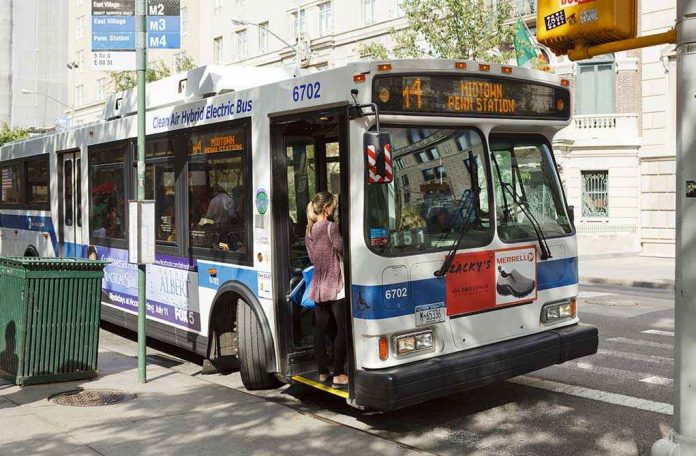
With nearly half of New York City bus riders skipping fares this year, the transit system is bleeding money while leaders argue over “free” buses and who should pay.
Story Highlights
- About 48% of bus riders did not pay in early 2026, according to reported MTA data.
- Bus farebox revenue fell tens of millions below plan in the first half of 2026.
- MTA leaders link fare evasion to “free bus” rhetoric; Mayor Zohran Mamdani rejects that claim.
- The agency is testing on-board checks and inspection teams to boost compliance.
Documented Spike in Bus Fare Evasion
Metropolitan Transportation Authority data shared in local reporting show bus fare evasion near one in two riders in early 2026. CBS New York cited a 48.2% evasion rate for the first quarter, describing it as a systemwide challenge. That level of nonpayment, even with modest fares, adds up fast on a high-ridership network. The figure is not brand-new, either. Outlets noted high evasion late last year, suggesting a stubborn trend that predates the latest political fight.
Budget-focused coverage reported a sharp shortfall in bus farebox revenue compared with plan in the first half of 2026. One report, citing agency documents, pegged the gap at roughly $35.7 million below expectations through June, reinforcing that evasion is not only about rule-breaking but also about paying for service. When planned rider payments do not arrive, officials must either cut service, raise other fares, or seek more tax dollars to close the hole.
Enforcement Tools Roll Out on Buses
Agency leaders responded with on-board validation devices and inspection teams sometimes called “Eagle Teams.” CBS New York reported that staff can now check payments on board and issue summonses. The New York Times reported a broader move to fare inspectors on buses, part of a proof-of-payment model used in some cities. These steps show the agency treating fare evasion as an operational and financial issue, not a one-off lapse. Actual compliance gains from these pilots are not yet clear.
Local press and riders have seen these checks on select routes, with plans to expand if they work. The model tries to speed boarding by removing the pay-at-the-door bottleneck while keeping random checks to deter cheating. Supporters say this balances speed and order. Critics worry about uneven enforcement and the risk of conflicts on crowded buses. The mix of speed, dignity, and fairness will likely shape whether the public accepts broader inspection across the network.
Politics of “Free” Buses and Who Pays
The fight over causes turned political this summer. New York Daily News reported that Metropolitan Transportation Authority Chair Janno Lieber linked higher evasion to “free bus” rhetoric, while Mayor Zohran Mamdani pushed back. Mamdani has long argued for free buses, with the city and state making the agency whole. That promise resonates with riders who struggle to afford fares, but it also raises a core question: where will the replacement money come from each year.
NYC bus ridership fell nearly 8% in June compared to same month last year. During Mamdani’s first 6 months in office, bus fare revenue fell by $31 million compared to the 1st half of 2025. Estimates show nearly half of bus riders now skip the $3 fare! https://t.co/osaq4dXUFh
— Foxy Maven (@FoxyMaven) August 15, 2026
Independent analysis cited by national outlets has pegged the cost of a free-bus policy near or above a billion dollars annually in lost fare revenue. That estimate does not settle today’s debate over rhetoric, but it frames the scale of funds the city and state would need to lock in to sustain free rides. Without a stable plan, the system risks service cuts or higher costs elsewhere. Both conservatives and liberals fear that elites will dodge hard trade-offs while everyday riders pay the price.
What We Know—and Do Not Know—About Causation
Reporting supports three facts: evasion is very high, revenue is below plan, and the agency is expanding enforcement. The record is thinner on what exactly caused the jump. Fare evasion was already elevated before the latest messaging fight, and no public surveys show riders skipping fares because of “free bus” talk. That does not dismiss leaders’ concerns; it just marks a limit in current evidence. Clearer data would help calm a polarized debate.
Why This Matters Beyond New York
Transit systems nationwide face the same bind: if riders do not pay, someone else must. The National Academies stress that replaced revenue must be stable, or service will slide. New York’s test of on-board checks will draw attention from other cities struggling with post-pandemic habits and trust. Riders on both left and right see a pattern: leaders talk big while systems break down. Measured enforcement, honest math, and transparent funding are the only way out.
Sources:
politicsny.com, nydailynews.com, cbsnews.com, news.moovitapp.com, nypost.com, onlinepubs.trb.org