

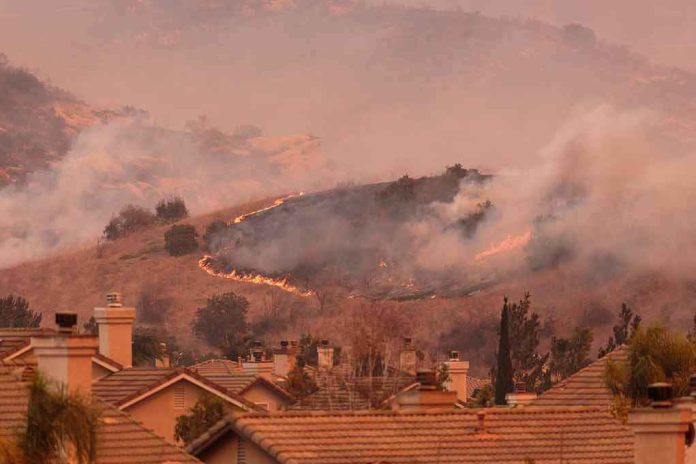
As fast-moving wildfires wipe out more than 600 structures around Spokane, thousands of families are learning how fragile basic safety becomes when government systems are stretched to the breaking point.
Story Snapshot
- Wildfires near Spokane have destroyed about 600 homes, businesses, and other buildings and burned over 5,000 acres.
- Roughly 5,000 homes have been evacuated, with some reports of more than 60,000 people under evacuation orders across the Spokane area.
- Governor Bob Ferguson declared a statewide emergency, activated the National Guard, and a “particularly dangerous situation” red flag warning was issued for eastern Washington.
- Years of growing fire risk, drought, and strained agencies show how exposed ordinary Americans are when major disasters hit.
Wildfires Rip Through Spokane-Area Neighborhoods
Authorities in eastern Washington say three major wildfires around Spokane have turned quiet neighborhoods into burn scars, destroying around 600 structures and leaving entire streets of homes in ruins. The Old Trails, Fairview, and Meadowview fires together have burned more than 8.2 square miles, or about 5,400 acres, around the city, with flames jumping the Spokane River and racing into residential areas. Reporters on the ground describe cars melted in driveways and block after block of houses reduced to ash.
Officials report that about 5,000 homes have been evacuated so far, and some national outlets cite evacuation orders affecting as many as 60,000 people across the broader Spokane area. Evacuation zones reach into Spokane County suburbs and nearby towns, forcing families to grab what they can and flee on short notice as winds push flames unpredictably. Power companies have cut electricity to some neighborhoods as a safety measure, leaving thousands without power while they wait to learn if they still have a home.
State Emergency, National Guard, and Red Flag Warnings
Washington Governor Bob Ferguson has declared a statewide emergency, ordered a burn ban through September, and activated the Washington National Guard to support exhausted local firefighters and sheriffs’ deputies. The National Weather Service issued a rare “particularly dangerous situation” red flag warning for eastern Washington, warning residents that extreme winds and dry fuel could turn any spark into a fast-moving firestorm. More than a quarter-million acres have burned statewide this season, with over 1,000 fires scorching forest, tribal land, farms, and neighborhoods.
Fire crews from Washington and Idaho, along with federal incident teams, are trying to hold lines around Spokane while other large fires burn across eastern Washington, including the Kaiser Canyon fire on the Colville Reservation and blazes in Franklin, Walla Walla, and Grant counties. Officials say their resources are stretched thin as they juggle dozens of fires across the West, forcing hard choices about where to send planes, helicopters, and crews when many communities feel like they are facing disaster at once.
Why These Fires Hit Nerves Across the Political Spectrum
Residents who already feel the system is failing them see these fires as another sign that ordinary people are left to fend for themselves while government lumbers behind. Homeowners who worked for decades to buy a house are watching it vanish in hours, and many worry that insurance fights, slow federal aid, and rising rebuilding costs will keep them from ever getting back to where they were. People on both the right and the left ask how, after years of warnings about drought, fuel buildup, and aging power lines, the country still reacts to each new disaster like it is a surprise.
Conservatives often blame heavy-handed environmental rules and slow forest management for thick brush and dead timber that feed mega-fires, while liberals point to a warming climate, underfunded safety nets, and rising inequality that makes recovery harder for working families. What they share is frustration that agencies talk about “resilience” while communities watch basic needs—safe housing, clean air, reliable power—collapse during crises. As smoke chokes eastern Washington and thousands sleep in shelters or with relatives, the gap between official promises and life on the ground feels wider than ever.
Eastern Washington’s Growing Fire Risk
Wildfire danger in eastern Washington has been rising for years as hotter summers, dry lightning storms, and long droughts turn grasslands and forests into tinder. State reports show dozens of fires each year burning more than 100 acres, with fire seasons now stretching longer and jumping more often into populated areas, not just remote timberland. Recent years brought deadly fires like the Gray Fire near Medical Lake, which burned thousands of acres and destroyed at least 185 structures, showing how quickly flames can move once they reach homes and highways.
Wildfires in eastern Washington state forced the evacuation of 60,000 people in the Spokane area while destroying at least 600 homes, businesses and other structures, authorities said Sunday. pic.twitter.com/WNF2EgaIxE
— The Associated Press (@AP) August 3, 2026
This season, the Kaiser Canyon fire alone has grown past 100,000 acres on the Colville Reservation, forcing tribal residents to evacuate and closing key roads, while other large fires in Franklin and Walla Walla counties have triggered repeated “go now” orders. The Washington Department of Natural Resources tracks these blazes across the state, but early damage numbers are often rough, which is why counts of destroyed structures and evacuated households keep climbing as crews finally reach burned neighborhoods and tally what is lost.
Sources:
washingtontimes.com, spokesman.com, en.wikipedia.org, clickondetroit.com, youtube.com, wasmoke.blogspot.com, usnews.com, frontlinewildfire.com, wfca.com, nytimes.com, komonews.com, facebook.com, fox13seattle.com, abcnews.com, npr.org, dnr.wa.gov, wftv.com, apnews.com