

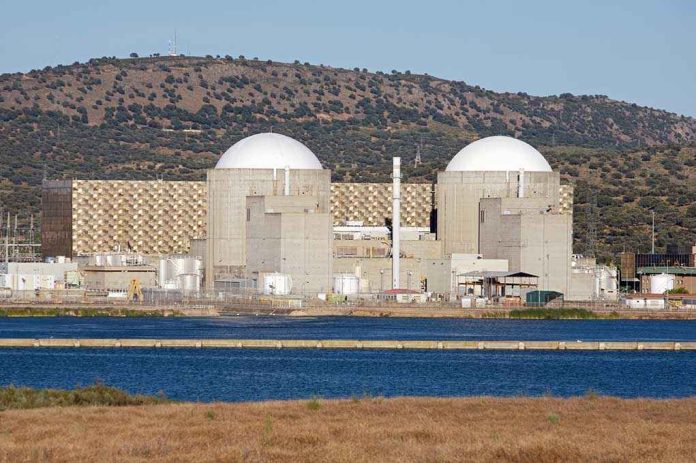
A massive $80 billion government-backed nuclear push promises up to 20 new reactors, but past overruns cast doubt on whether this will deliver affordable energy or repeat costly failures.[4][6]
Story Snapshot
- US Department of Commerce partners with Westinghouse, Cameco, and Brookfield for at least $80 billion in AP1000 reactor construction across the United States.[3][4]
- Cameco executives project up to 20 large AP1000 reactors, citing a May 2025 executive order targeting 10 plants under construction by 2030.[1][4]
- Government facilitates financing, permitting, and approvals to revive nuclear supply chains and create over 100,000 jobs.
- Vogtle Units 3 and 4, the only completed US AP1000s, suffered $35 billion costs—over double the $14 billion budget—and 7-8 year delays.
- Analysts estimate $80 billion supports only 6-10 reactors, amid competition and historical execution gaps in energy projects.[6][2]
Partnership Details and Commitments
President Donald Trump announced the strategic partnership on October 27, 2025, between the US Department of Commerce, Westinghouse Electric Company, Brookfield Asset Management, and Cameco Corporation.[4] The binding term sheet targets at least $80 billion in new Westinghouse AP1000 reactors.[3] The government arranges financing for long-lead items and streamlines permitting. Westinghouse plans immediate orders for critical equipment, leveraging Vogtle supply chains.
Cameco Chief Operating Officer Grant Isaac highlighted the deal at a conference, calling nuclear a “security play” with 2026 as a pivotal year for gigawatt-scale builds.[1] A May 23, 2025 executive order supports 10 large plants by 2030.[4] The AP1000 features passive safety systems and modular design for efficiency.
AP1000 Technology and Safety Record
The AP1000 pressurized water reactor uses passive safety to shut down without operator action, achieving a core damage frequency of 5.09 × 10⁻⁷ per plant per year per Nuclear Regulatory Commission data.[5] It offers the smallest footprint per megawatt electric among reactors. Vogtle Units 3 and 4, operational since 2023 and 2024, prove commercial viability despite challenges. The Nuclear Regulatory Commission extended AP1000 design certification to 2046, easing future licenses.[4]
A study projects a fleet of 10 AP1000s generating over $1 trillion in GDP over 80 years through jobs and power.[5] Proponents emphasize reinvigorating US nuclear capacity amid rising energy demands from AI data centers and manufacturing.[1]
Challenges from Past Projects and Skepticism
Vogtle Units 3 and 4 exemplify risks: initial $14 billion budget ballooned to over $35 billion, with online dates slipping from 2016-2017 to 2023-2024. Critics question scaling “Vogtle 4 over and over” given supply constraints and overruns.[1] Industry analysts peg $80 billion at 6-10 reactors, not 20.[6] The US Department of Energy explores AP1000 alternatives amid slow talks.[2][7]
An #energy sector meltdown today is dragging down #Uranium #stocks in spite of Cameco's blow-out earnings.🎆📉⚛️⛏️ To learn why U need to buy the dip♈️🛒 I highly recommend reading @YellowBull11's Conference Call synopsis as Cameco now expects US to build 20+ AP1000 reactors!🤠🐂 https://t.co/8rI1yYrFnq pic.twitter.com/wVR1HNgpec
— John Quakes (@quakes99) May 5, 2026
This fits a pattern of ambitious energy announcements falling short, like Obama-era solar targets hitting half projections or stalled hydrogen initiatives.[Neutral context] Both conservatives frustrated by high renewable costs and liberals wary of inequality seek reliable power, yet government promises often prioritize politics over delivery, fueling distrust in federal competence.[4]
Sources:
[1] Cameco Conference: COO Says Nuclear “Fully Emerged” as …
[2] AP1000 faces competition in US – Nuclear Engineering International
[3] Strategic Partnership | Westinghouse Nuclear
[4] US Government Announces Historic $80 Billion Nuclear Partnership …
[5] Study highlights economic impact of US fleet of AP1000s
[6] Big American Nuclear Revival! Cameco, Brookfield, and …
[7] Westinghouse Looks To Build Out Supply Chain As Part of $80 …