

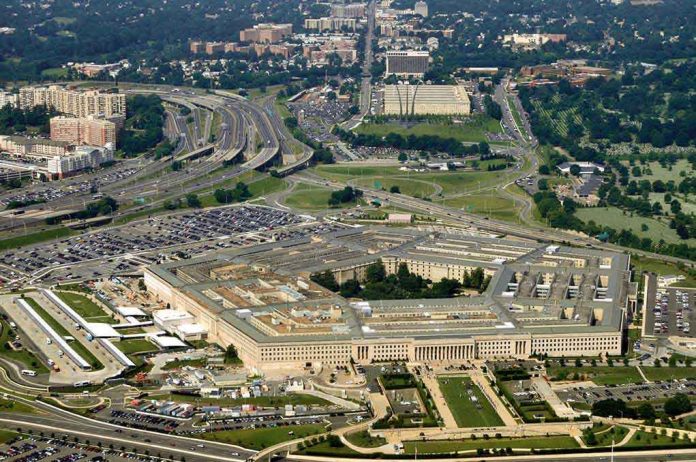
Pentagon insiders say President Trump is preparing to fire entrenched four-star brass and rip out the last vestiges of Biden-era “woke” policies to rebuild a leaner, war-ready U.S. military.
Story Snapshot
- Trump’s team is weighing a sweeping shake-up of U.S. military commands, including pushing out multiple four-star generals.
- The reshaping builds on his first-term record of higher defense spending, Space Force creation, and defeating ISIS while avoiding new wars.
- DEI programs and transgender policies are being rolled back in favor of combat readiness, technology, and discipline.
- A new Department of Government Efficiency ties Pentagon changes to a broader crackdown on wasteful, bloated bureaucracy.
Trump’s Second-Term Vision: From ‘Woke Force’ to Warfighting Force
Reports out of the Pentagon describe senior officials discussing a major reorganization of U.S. military commands, with an eye toward cutting layers of bureaucracy and even removing some four-star officers who resisted change. The goal is not to weaken American power but to put warfighting, not social engineering, back at the center of the armed forces. Trump’s America First vision treats the Pentagon like any other agency: accountable to voters, not an untouchable priesthood of career insiders.
Trump’s allies frame the shake-up as a necessary course correction after years of drift under Obama and Biden, when defense leaders chased climate agendas, gender politics, and diversity metrics instead of lethality. In this view, a smaller cadre of battle-focused commanders, backed by modern weapons and clear goals, better protects American families than a sprawling command structure obsessed with PowerPoints and pronouns. The coming battle is over who truly runs the military: elected civilians or a self-protecting class of generals.
First-Term Record: Rebuilt Strength Without New Endless Wars
Supporters point to Trump’s first term as proof he can rebuild strength while avoiding the kind of open-ended foreign adventures that cost lives and fuel debt. His administration poured roughly $2.2 trillion into defense, restored pay raises, and launched the Space Force, the first new branch since 1947, even as he refused to start a new major war. ISIS’s territorial caliphate was destroyed, its leader Abu Bakr al-Baghdadi killed, and Iran’s top terror commander Qassem Soleimani eliminated, sending a message without occupying another country.
At the same time, Trump pressed NATO to carry more of its own weight and signaled that American troops would no longer be the world’s default security blanket. Analysts note that much of the early defense money went to maintenance, readiness, and nuclear and cyber modernization, rather than simply buying shiny new hardware. For conservatives frustrated with globalist adventures and Pentagon waste, that balance—strong deterrence, fewer quagmires—looked like common sense. His second term’s shift toward long-range missiles, uncrewed systems, and space-based capabilities builds directly on that foundation.
Cracking Down on DEI, Social Engineering, and Bureaucratic Bloat
The most controversial part of Trump’s second-term military agenda is the explicit targeting of DEI bureaucracies and social experiments that seeped into the ranks during the Biden years. The administration has already moved to end Pentagon-level DEI offices, reverse transgender service policies, and pull training materials that framed the military through the lens of race and gender ideology. For many conservative service members and veterans, these changes are overdue recognition that a rifle platoon’s job is to win wars, not meet HR quotas.
Critics argue that dismantling DEI structures could hurt recruitment among certain groups and disrupt long-standing civil-military norms. But Trump’s team points out that the services have recently been meeting or beating recruitment goals even as these offices are pared back, suggesting that patriotic Americans are still eager to serve a mission-focused force. The bigger question is whether promotions and command slots go to proven warfighters or to officers who built careers championing fashionable theories. The firings of senior DEI-aligned leaders send a clear signal about where this administration stands.
DOGE, Command Cuts, and the Future of American Power
The Pentagon overhaul is closely linked to Trump’s new Department of Government Efficiency, which was created to slash dead weight across the federal bureaucracy. DOGE’s mission includes examining overlapping commands, redundant staffs, and civilian billets inside the Defense Department that add cost without adding combat power. Proposals under discussion include consolidating geographic commands, trimming four-star positions, and pushing more authority down to leaner, combat-focused headquarters that can move faster in a crisis.
Strategically, the shift could mark the end of the old “Pax Americana” model, where Washington policed the entire globe at enormous financial and human cost. By emphasizing advanced deterrent technologies, stronger borders, and higher allied contributions, Trump aims to keep America unmatched militarily while refusing to serve as the world’s social worker. For conservatives weary of endless wars, mounting debt, and politicized brass, a tougher, slimmer, constitution-minded military looks less like a risk and more like the reset they have demanded for decades.
Sources:
Trump is changing how the military is commanded. Is it dangerous?
Executive and Regulatory Actions: Trump Administration 2.0
Tracking regulatory changes in the second Trump administration
Populist disruption? Trump and contemporary American civil–military relations
The End of Pax Americana Under Trump 2.0?