

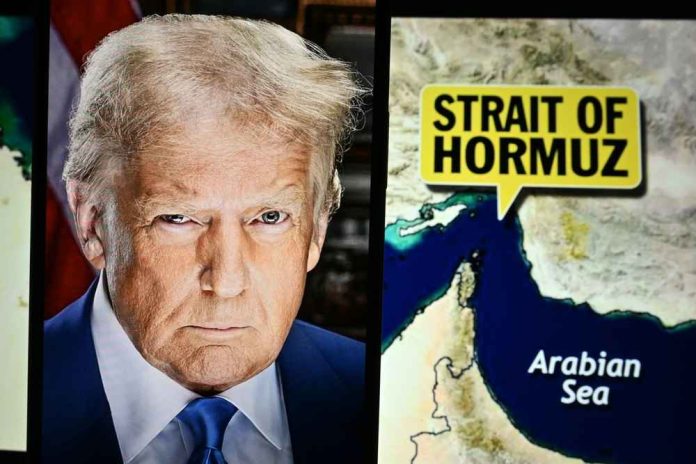
As U.S. bombs pound Iran and Iranian missiles slam into American bases and Gulf allies, Washington and Tehran are turning one of the world’s key energy chokepoints into a slow-motion crisis that ordinary people will pay for in higher prices and deeper instability.
Story Snapshot
- The U.S. is intensifying airstrikes across Iran and tightening a naval blockade, saying it must protect commercial shipping and keep the Strait of Hormuz open.
- Iran is firing back with missile and drone attacks on U.S. bases and U.S‑aligned governments in Bahrain, Kuwait, Qatar, Oman, and Jordan, and claims to have closed the Strait of Hormuz.
- Both sides say they are acting in “self‑defense,” but each strike deepens a tit‑for‑tat cycle that has already shattered a fragile ceasefire and risks a wider regional war.
- The fighting threatens global oil flows, and it feeds a familiar fear at home: that America is sliding into another open‑ended conflict driven more by elites and strategic games than by the needs of working families.
What Just Happened: Strikes, Blockade, And A Broken Ceasefire
The latest flare‑up began after Iranian forces hit commercial ships and a container vessel in the Strait of Hormuz, a narrow waterway that once carried about a fifth of the world’s traded oil. U.S. Central Command says it answered with waves of strikes on Iran’s southern coast, hitting radar, missile and drone launch sites, ammunition depots, small naval craft, and ports around Bandar Abbas, Sirik, Qeshm Island, and nearby areas. U.S. officials say these attacks are meant to “degrade” Iran’s ability to target civilian mariners and commercial vessels.
Okay, let’s get you caught up on where we’re at with Iran.
As you know that fragile ceasefire established under June negotiations has completely gone to sh*t due to persistent Iranian aggression.
Following Tehran's hostile attacks on commercial vessels in the vital Strait of… pic.twitter.com/cZxumuo8Ac
— Right Wing Tool (@RightWingTool) July 16, 2026
As the strikes grew, the Trump administration reinstated and then tightened a blockade on ships “to and from Iranian ports and coastal areas,” giving U.S. forces broad power to stop or turn back traffic linked to Iran. U.S. commanders describe the blockade as a way to keep sea lanes open by choking off Iran’s ability to threaten them. Critics at home and abroad hear something different: Washington again using military and economic power to police a region thousands of miles from U.S. shores.
How Tehran Hit Back: Gulf Allies In The Crossfire
Iran’s leaders have answered U.S. strikes with their own show of force, hitting not only American sites but also U.S. partners across the Gulf. Iranian missiles and drones have targeted bases and facilities in Bahrain, Kuwait, Qatar, Oman, and Jordan, which Tehran casts as “legitimate” responses to American bombing of its coastal cities and ports. Iran’s Islamic Revolutionary Guard Corps claims to have struck dozens of “critical” U.S. military locations, including a Navy command center and an air base, and says its regional reach remains intact despite U.S. attacks.
At the same time, Iran says it has “closed” the Strait of Hormuz and fired on vessels it calls violators, including a Cyprus‑flagged container ship, as part of an effort to push U.S. and allied forces out of the area. Iranian officials insist the United States broke a recent memorandum of understanding by resuming bombings and sanctions, and they frame their response as defense of national sovereignty. But every missile fired at Gulf states pulls more countries into the line of fire and raises the odds that one miscalculation could turn a contained air war into something far wider.
Why Both Sides Say ‘Self‑Defense’ — And Why Many Americans Do Not Buy It
U.S. statements stress that every new strike is “retaliatory” or “entirely defensive,” answering what Washington calls unprovoked Iranian aggression against U.S. troops and commercial shipping. Iran uses almost the same language, calling U.S. bombings “war crimes,” accusing Washington of hitting civilian infrastructure, and claiming that it is forcing the United States to respect ceasefire terms and Iranian control over nearby waters. This mirror‑image messaging is not new; for decades each side has cast itself as guardian of law and order while painting the other as the reckless actor.
For Americans watching from home, the pattern feels painfully familiar. Republicans who backed “America First” wanted fewer foreign wars and more focus on secure borders, affordable energy, and a strong middle class. Democrats warning about endless conflict wanted less power in the hands of generals and war contractors. Yet here we are again: drones, missiles, and blockades in a far‑off sea, while families at home still face high costs, weak trust in institutions, and a sense that neither party is listening.
Energy, Economics, And The Warning Sign For Ordinary Families
The Strait of Hormuz is not just a distant map point; it is a pressure valve for the global economy. Before the war, tankers hauled massive volumes of oil and natural gas through that narrow channel every day. Every threat to close it, every missile near a tanker, sends traders scrambling and pushes prices up. Analysts already report sharp jumps in oil futures as Iran fires on ships and the United States expands its blockade, and history says higher fuel and shipping costs do not stay “over there” for long.
Here’s the snapshot of global event:
*MENA Region*
*Energy + Hormuz shock*: Oil surged recently, with traders running the "NACHO" trade — "Not a Chance Hormuz Opens" — betting the Strait of Hormuz stays restricted. About 20% of global oil normally passes through it, and with…— ⓒⓐⓡⓝⓐⓣⓘⓞⓝ™ (@xarnation) July 16, 2026
Working families, farmers, and small businesses feel those shocks first in gas prices, heating bills, and grocery costs. Conservatives see yet another example of global instability driving up energy prices after years of fights over domestic drilling and green mandates. Liberals see another crisis where the richest oil firms and defense contractors may end up fine while low‑income workers struggle. Both sides see a Washington establishment that always finds money for warplanes and missiles, but rarely the same urgency for broken schools, addiction, or crumbling roads.
Deeper Pattern: A Cycle Of Escalation And A Failing Elite Playbook
This latest round of attacks is not a clean break from the rest of the 2026 conflict; it is part of a grinding cycle that has repeated several times since the first big strikes in February. A ship or base is hit, one side launches “limited” retaliation, the other answers, and a temporary deal or ceasefire is announced. Then another incident — a drone, a warning shot, a new set of sanctions — knocks the truce apart within days or weeks, and the cycle restarts with more targets and higher stakes.
Strategists talk about “deterrence,” “freedom of navigation,” and “regional credibility.” Regular citizens look at a 108‑day conflict that was supposed to be short and “surgical” and see mission creep and mixed motives. They see leaders on all sides making decisions that risk oil shocks, new refugee flows, and even a larger war, while still failing to deliver safety, prosperity, or honest government at home. That feeling — that the system serves distant interests and entrenched elites before it serves the people — is the common thread tying together the anger of conservatives and liberals who otherwise agree on very little.
Sources:
youtube.com, bbc.com, nytimes.com, washingtonpost.com, cnbc.com, reuters.com, apnews.com, jpost.com, cbsnews.com, axios.com