

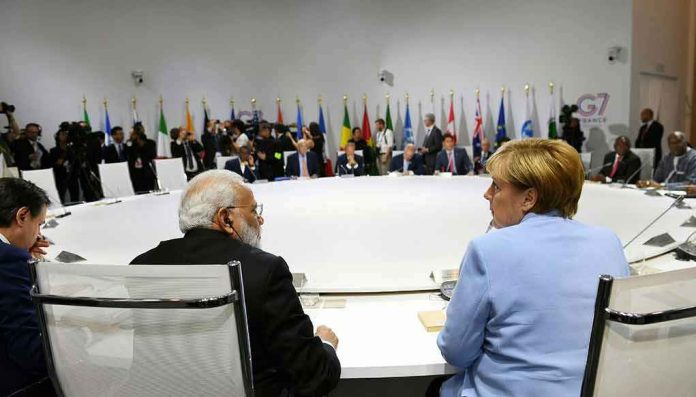
G20 nations, including China, just agreed that no country should build a brand-new watchdog agency just to police artificial intelligence.
Quick Take
- G20 innovation ministers meeting in North Carolina reached consensus on the “Carolina Principles for Emerging Technologies,” a U.S.-backed plan to limit new AI-specific rules.
- The White House says the principles push countries to invest in research, help companies bring AI products to market, and avoid creating new AI regulators.
- China signed on, a rare moment of agreement between Washington and Beijing on tech policy.
- The deal is non-binding, meaning countries can still write their own AI laws if they choose.
- Tech leaders like Elon Musk and David Sacks spoke at the summit, warning against what Sacks called an “FDA for AI.”
What The G20 Agreed To
Ministers from G20 countries met in Chapel Hill and Asheville, North Carolina, on September 1 and 2, 2026. They signed off on the Carolina Principles for Emerging Technologies. The White House says the principles call on countries to invest in foundational research, help companies turn ideas into products, and support safe use of new technology without heavy-handed rules.
A separate United Kingdom government summary confirms the same outcome. It states the ministers who gathered in North Carolina agreed on a statement that includes the Carolina Principles as one of its main deliverables. The document also covers broader pro-innovation policy goals tied to artificial intelligence and other emerging technologies.
G20 Nations Including China Back US-Led ‘Carolina Principles’ Rejecting Strict AI Regulation, as Musk and Zuckerberg Warn of a Power Shortfall
All G20 member nations, including China, unanimously endorsed a US-proposed framework called the Carolina Principles at the close of the… pic.twitter.com/A1vBtFobIh
— BeezLoop News 📰🗞️ (@BeezLoop) September 7, 2026
Why The U.S. Pushed This Plan
Before the deal closed, the United States pressed G20 members to take a hands-off approach to AI regulation. Reuters reported the U.S. asked countries to avoid creating new rules built specifically for AI technology. White House tech adviser Michael Kratsios led the push, arguing that new AI-only regulators would slow innovation without making the technology safer.
The plan asks governments to use their existing sector rules instead of building fresh AI bureaucracies. New rules should only come when a real, new problem shows up, not as a blanket precaution. Supporters say this keeps rules focused on actual harms in areas like finance, health care, or transportation, rather than treating AI as one giant category needing its own police force.
A Rare Moment Of US-China Agreement
China backed the Carolina Principles too, which analysts called a rare instance of the U.S. and China finding common ground on tech policy. Both countries already regulate AI differently in practice, so the agreement works more as a shared statement of intent than a strict rulebook. The European Union, which favors stronger AI-specific oversight, is not expected to change its own tighter rules because of this statement.
Industry Voices At The Summit
Business leaders showed up in force. Commerce Secretary Howard Lutnick spoke with Nvidia chief executive Jensen Huang during the event, and Elon Musk joined White House adviser David Sacks for public remarks at the gathering. Sacks warned against building what he called an “FDA for AI,” arguing that a single powerful regulator could slow down helpful new tools before they reach the public.
The US told G20 governments to stop singling out AI in regulation. China signed the Carolina Principles. The EU responded by extending its own high-risk AI compliance deadline by 16 months to December 2027. Two live experiments. Neither is finished.
— Pankaj Kharode (@pankajkharode) September 7, 2026
This debate is not new. The Organisation for Economic Co-operation and Development set the first international AI standard back in 2019, and G20 leaders later adopted similar non-binding AI principles based on that work. History shows that countries often agree on broad, soft language first, then argue later over how strict the real laws should get once companies start building and selling the technology.
What Comes Next
The Carolina Principles carry no legal force. Each G20 country can still pass its own AI laws, and the European Union already plans to keep its stricter framework in place. The bigger test will come as countries decide whether to turn these shared words into real policy, or whether the agreement fades once national interests and competing tech ambitions pull governments back toward their own separate rulebooks.
Sources:
townhall.com, whitehouse.gov, gov.uk, bostonglobalforum.org, clarityupsc.com, en.sedaily.com, letsdatascience.com, explainx.ai