

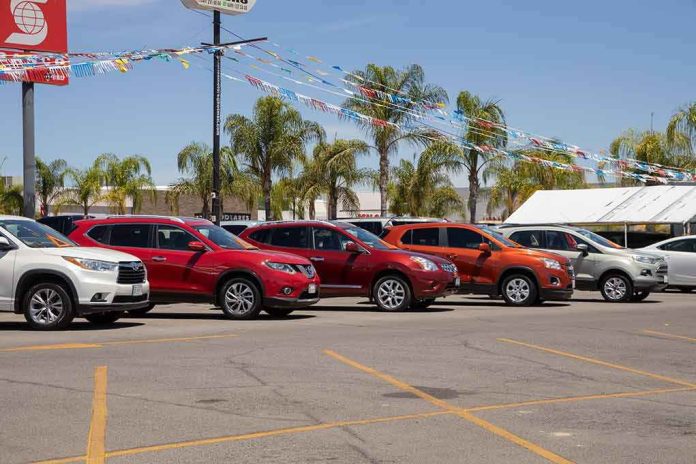
The price of your next new car could come down about $930, the Transportation Department estimates, after President Trump approved new fuel-economy rules that end the Biden-era push toward electric vehicles. The old rules pushed carmakers to build more electric vehicles to meet rising mileage targets, and the administration says those costs showed up in sticker prices.
Quick Take
- On Saturday, September 26, Trump announced on Truth Social that he approved new fuel-economy standards ending what he calls Biden’s EV mandate.
- The Transportation Department estimated its proposal would cut the average cost of a new vehicle by about $930.
- The 2031 target drops from 50.4 miles per gallon to about 34.5 miles per gallon.
- Transportation Secretary Sean Duffy called it “a major victory for America’s auto workers” and said it is coming Monday.
Trump Announces the Rollback
Trump made the announcement in a Truth Social post. “I have just approved new Fuel Economy Standards that TERMINATE Sleepy Joe Biden and Pete Boot-EDGE-EDGE’s ridiculous EV Mandate,” he wrote. He tied it straight to the buyer’s wallet: “That means LOWER PRICES, saving families thousands on a new, beautiful, and safe car.” The Transportation Department’s own estimate is about $930 per vehicle, on new cars that now average roughly $50,000.
A U.S. official said the new Corporate Average Fuel Economy standards, known as CAFE, would be finalized Monday. Secretary Duffy posted that “a major victory for America’s auto workers is COMING MONDAY.” The move fits a broader effort by the administration to unwind the climate-focused vehicle rules put in place under President Biden.
What the New Numbers Show
The new rule sets an average of about 34.5 miles per gallon for cars and light trucks by 2031. That is a steep drop from the 50.4 miles per gallon standard set under President Biden. Lower targets mean car companies face less pressure to build electric vehicles to balance out their gas-powered lineups, since the fleet average becomes easier to meet with regular engines. The administration says less pressure means lower costs that reach the buyer.
The White House laid out the same goal when it first announced this reset in December 2025. It said it was returning the standards “to levels that can actually be met with conventional gasoline and diesel vehicles.” For a buyer, that means more gas and diesel models to choose from, and less of the cost of building electric cars folded into the price of every car on the lot.
A Pattern That Keeps Repeating
Fuel economy rules have swung back and forth for decades, tightened under one administration and loosened under the next. The standards began in 1975 after the energy crisis, not as a climate policy, and lawmakers and regulators have adjusted them many times since.
There is a trade-off for your wallet down the road. The Transportation Department projected the lower targets would raise fuel use by about 100 billion gallons through 2050 and add about $185 billion in fuel spending nationwide. The savings come up front at the dealer, while cars that burn more gas cost more to fill over the years.
CAFE standards are fleet-wide averages, not a direct ban on gas-powered cars. But because higher mileage targets push automakers to sell more electric vehicles to balance their numbers, many people call the rule an “EV mandate.” Either way, lower targets mean less pressure on car companies to build and sell electric models.
What Comes Next
The full text of the new rule has not been released yet, and officials said the standards will be finalized Monday. Once it is public, the details for each model year will be clear. For a buyer, the thing to watch is the sticker: whether the roughly $930 in savings the department estimated shows up on dealer lots. For now, gas-powered vehicles get a longer runway, and the push toward electric cars is off.
Sources:
redstate.com, cnbc.com, thehill.com, whitehouse.gov, yahoo.com, newsweek.com