

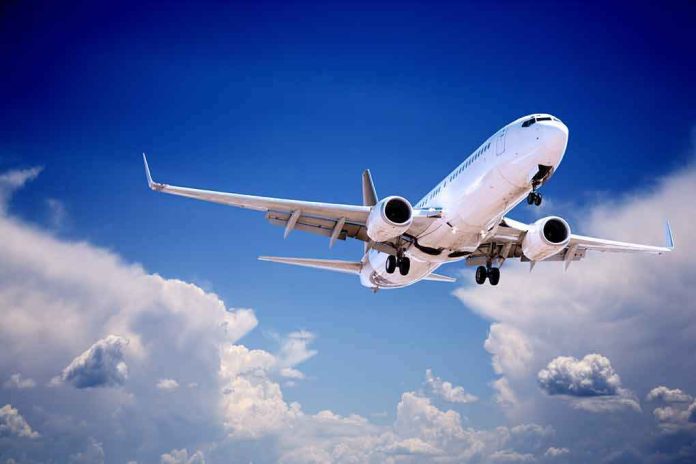
Boeing is working on a permanent fix for a 737 MAX software flaw that can switch off the jet’s automated flight guidance after a missed landing approach. The problem came from a cockpit software update, and it shows up when pilots fly a different path than the one they planned after they abort a landing. The flaw became public on Saturday, September 26, through a newspaper report, though Boeing had already told all 737 airlines about it in August.
Story Highlights
- A software flaw can switch off the 737 MAX’s automated flight guidance after a missed approach.
- Boeing told airlines to have pilots reset the system after a missed approach until a fix is ready.
- The Federal Aviation Administration will convene a Corrective Action Review Board on the issue.
- Southwest and United asked Boeing to deliver new jets with an earlier software version.
What Boeing Told Airlines About the Glitch
In August, Boeing informed all 737 operators about a software issue where pilots may lose access to automated flight guidance during one landing scenario. It happens after a missed approach, when a crew circles around and changes its planned flight path. When that occurs, the autopilot drops back to simpler automation, and the pilots have more work to do. Boeing told airlines to have pilots reset the system after a missed approach as a precaution. “Our engineers are working on a software update to permanently address the issue,” the company said.
🔴 @BoeingAirplanes has flagged a software glitch on the 737 Max: during a go around on a precision approach with autopilot engaged, VNAV can disengage and drop to a more basic pitch control mode, raising pilot workload at a critical moment. FAA is now reviewing whether this is a… pic.twitter.com/4xYPRmpdC1
— Avgeek Jan (@Avgeek_Jan) September 27, 2026
The flaw touches a narrow part of flight. It appears after a go-around, not during normal descent or cruise. That matters because a missed approach is a busy moment in the cockpit, with the crew climbing, turning and setting up for another try. Boeing shared guidance that backs up current pilot procedures rather than issuing any grounding or stop order.
What Federal Regulators Are Doing
The Federal Aviation Administration said it is aware of the issue. The agency said it will convene a Corrective Action Review Board and will take immediate action if it identifies a safety concern. For now, airlines keep flying the jets under the steps Boeing has shared.
Regulators work in the shadow of the earlier 737 MAX crisis. After two crashes in 2018 and 2019, the plane was grounded worldwide, and reviews found problems with how its software was designed and approved. Nothing so far ties the new flaw to that crisis. Still, that history shapes how travelers and regulators view even a narrow software problem on this model.
What Airlines Are Doing
Two big U.S. carriers are not waiting for the fix. Southwest Airlines and United Airlines asked Boeing not to deliver new 737 MAX jets with the affected software and to use an earlier version instead. Boeing has delivered more than 2,400 737 MAX jets to airlines around the world. Officials have not said how many of them carry the flawed software.
For travelers, the key point is that pilots train for go-arounds and can fly a landing without the automated guidance. For crews, the focus is on workload during a busy phase of flight and on clear reset steps if the guidance drops out. For regulators, the test is a fast, open review. Boeing says a permanent software update is coming. The Federal Aviation Administration says it will act if it finds a safety concern. Real confidence will come when the update is built, tested and installed.