

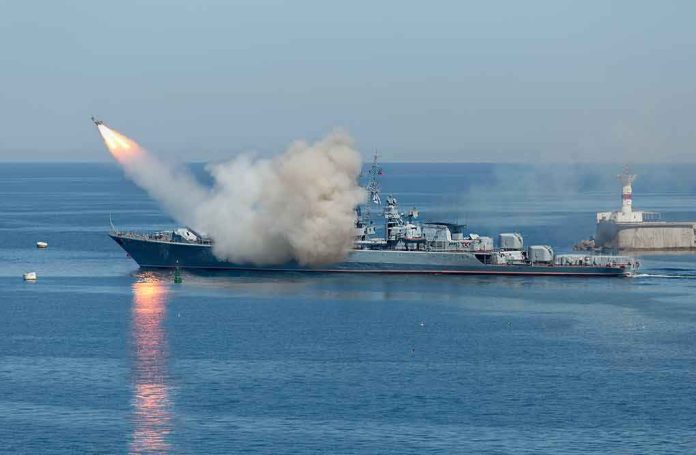
U.S. forces hit Iranian launchers near the Strait of Hormuz, and Iran fired back at U.S. bases in Jordan within a day—restarting a dangerous cycle after a month-long lull.
Story Snapshot
- U.S. Central Command struck two Iranian launchers on Larak Island, citing a threat to shipping.
- Iran’s Islamic Revolutionary Guard Corps said it retaliated with missiles and drones at U.S. bases in Jordan.
- Jordan’s military said it intercepted eight missiles that entered its airspace.
- This was the first reported U.S.-Iran exchange of direct fire in about a month.
What Triggered The Exchange
U.S. Central Command said American forces struck two Iranian rocket launchers on Larak Island on August 30. The command stated its forces saw Iranian units preparing rockets equipped with sea mines that could threaten the Strait of Hormuz. The U.S. framed the strike as a move to protect civilian mariners and the flow of global trade through the waterway. ABC News and CNBC reported it was the first U.S. strike on Iranian territory since late July, breaking a month of relative quiet.
Iran’s Islamic Revolutionary Guard Corps said it responded by launching missiles and drones at U.S. bases in Jordan, naming King Hussein and Al Azraq as targets. Iranian media carried the statement, and major outlets reported the claim. Reuters described the action as retaliation for the Larak Island strike, reflecting Iran’s message that it was acting in self-defense after U.S. and Israeli actions against Iran. Public reporting did not independently confirm the full extent of damage claimed by Iran.
How Jordan And The U.S. Reacted
Jordan’s armed forces said air defense systems intercepted eight missiles that crossed into Jordanian airspace at dawn on Monday. Reports did not detail significant damage at the named bases. Outlets tracking the sequence agreed on the order of events: a U.S. strike on Larak Island, followed by Iran’s attack toward U.S. positions in Jordan. Officials did not release casualty figures, and available reports noted limited detail on impacts at the bases beyond the interceptions.
American officials characterized the Larak operation as a defensive action to keep the Strait of Hormuz open for shipping. CNN reported U.S. messaging that the strike aimed to neutralize a direct risk to mariners and global trade routes. That framing matches past U.S. efforts to show narrow goals, reassure Gulf partners, and reduce the chance of a wider war. It also fits a longer pattern of limited U.S.-Iran moves meant to signal resolve without tipping into a larger conflict.
Why This Moment Matters For Ordinary Americans
The Strait of Hormuz moves a large share of the world’s oil. Any threat there can raise fuel prices and shipping costs fast. When U.S. officials say they act to keep trade moving, they speak to real risks for family budgets and small businesses. When Iran strikes back, it reminds everyone that one clash can ripple through energy markets and supply chains. This cycle drains attention and money while many feel Washington’s leaders dodge hard domestic problems.
Both parties know the public is tired of endless shows of force that do not solve the core dispute. Many Americans on the right and left believe elites make choices that ordinary people pay for. They see rising costs and fear that national security decisions serve insiders, not citizens. Episodes like this—targeted strikes, quick retaliation, and thin public details—feed that belief. People want clear goals, honest measures of success, and a path that lowers risk at home.
The Broader Pattern Of “Calibrated” Moves
Major outlets say the latest actions match a familiar pattern: attack, response, and more pressure. Analysts quoted by Reuters describe Iran’s strategy as raising costs across shipping lanes and energy routes to force concessions, while avoiding a fight that Iran cannot win outright. Washington tends to answer with limited, targeted strikes it calls defensive and preventive. The result often looks like stability on the edge—predictable, but still risky.
This exchange also shows how regional partners, like Jordan, work to contain damage. Jordan’s interceptions limited fallout and restrained escalation on its soil. That matters as the United States balances support for partners with the need to avoid a broader war. At the same time, incomplete public data on damage and casualties leaves many questions that officials may answer later. For now, the key fact stands: both sides traded fire again after a pause of about a month.
What To Watch Next
Watch for new satellite images of Larak Island and the Jordan bases that could confirm what was hit and how hard. Look for updated U.S. and Jordan statements on damage, and for any follow-on strikes or intercepts in the coming days. Keep an eye on oil prices and shipping speeds through the Strait of Hormuz. If both sides stick to limited shots and careful messages, tensions may cool. If targets widen, costs will rise fast for everyone tied to global trade.
Sources:
theamericanconservative.com, abcnews.com, english.news.cn, reuters.com, cnn.com, cbn.com