

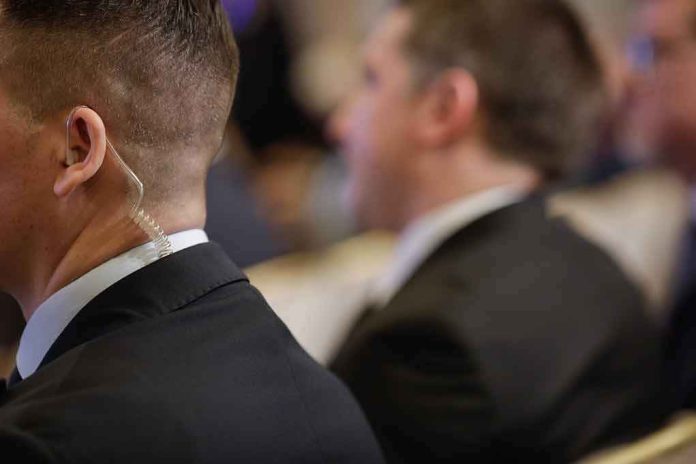
Federal agents say a man watched security prep at President Trump’s Los Angeles golf course, then returned with a loaded gun in his car as officers closed in.
Story Snapshot
- Investigators tied the arrest to advance security planning for President Trump’s visit.
- Deputies say they found a loaded pistol, a 16-round magazine, and ammunition.
- Prosecutors filed a federal charge for an unregistered short-barreled rifle found at his home.
- A judge later paused the case and sent the defendant to mental health court.
What Investigators Say Happened On The Ground
Los Angeles County deputies say they first saw the man on the Trump National Golf Club grounds in Rancho Palos Verdes. They report he wore an earpiece and took photos and videos as federal teams prepared for President Trump’s visit. Authorities say he returned the next day and claimed he worked for the State Department. They say he admitted there was a loaded gun in his vehicle before deputies detained him and searched the car.
Deputies and reporters’ summaries say the search recovered a 9-millimeter pistol, a 16-round magazine, and ammunition. One report also notes a badge that read “security protection agent.” These items, investigators say, raised concern about possible scouting of security procedures. Officials have not stated a motive. They have not said the conduct was an attempted attack. They have said the behavior was suspicious and warranted action near a sitting president.
𝐉𝐔𝐃𝐆𝐄 𝐑𝐔𝐋𝐄𝐒 𝐀𝐑𝐌𝐄𝐃 𝐌𝐀𝐑𝐈𝐍𝐄 𝐕𝐄𝐓 𝐖𝐇𝐎 𝐒𝐓𝐀𝐋𝐊𝐄𝐃 𝐓𝐑𝐔𝐌𝐏’𝐒 𝐆𝐎𝐋𝐅 𝐂𝐋𝐔𝐁 𝐖𝐈𝐓𝐇 𝐌𝐄𝐋𝐀𝐍𝐈𝐀’𝐒 𝐒𝐂𝐇𝐄𝐃𝐔𝐋𝐄 𝐔𝐍𝐅𝐈𝐓 𝐅𝐎𝐑 𝐓𝐑𝐈𝐀𝐋
A Los Angeles County judge just froze the prosecution of the man caught casing 𝐓𝐫𝐮𝐦𝐩… pic.twitter.com/nvlph7HrPb
— M.A. Rothman (@MichaelARothman) August 27, 2026
From Detention To Federal Firearms Charge
The United States Secret Service spokesperson posted that federal charges followed an investigation tied to “suspicious activity” during advance security planning for the Los Angeles visit. That public statement linked the arrest to preparations for protecting President Trump. It did not claim a completed plot. It framed the case as proactive protection work leading to charges after review by investigators and prosecutors.
United States prosecutors then filed a criminal complaint. They charged the man with possessing an unregistered short-barreled rifle. Reports say agents found that rifle at his home, along with body armor, magazines, ammunition, and notebooks with concerning notes. The federal firearms count can carry up to 10 years in prison if proven. That filing shows the case moved past rumor into a formal charge in court.
Courts, Conditions, And A Mental Health Turn
Local coverage says the man pleaded not guilty in an early hearing. A judge set bail at two hundred fifty thousand dollars. The court ordered him to stay away from the golf club, avoid weapons, and remain in California. Authorities also noted he was under a separate police investigation for robbery in a nearby city, which raised their overall risk view. That separate matter has not been linked by officials to the golf course events.
Weeks later, an Associated Press report says a judge suspended the criminal case and sent it to mental health court after a pretrial evaluation found the defendant not mentally fit to stand trial. The same report quotes the public defender saying it was too early to know how mental health would shape any defense. The evaluation describes him falsely claiming long service with the State Department, which officials say he does not have.
Why This Case Hits Nerves Across The Spectrum
Secret Service doctrine treats even unclear behavior near a protectee as a trigger for action to prevent harm. That approach helps stop attacks. It also means police can move fast with only partial facts in public view. People on the right and left worry that institutions either hide details or hype risk to protect their image. This case shows both sides of that tension, with a quick arrest and a later mental competency pause in court.
of drawings and sketches of Trump National Golf Club Los Angeles in Rancho Palos Verdes, lists of USSS schedules, details about individual security personnel and copies of Melania Trump’s schedule.
— Fort Bastion ⚔️ (@FortBastion) August 27, 2026
For citizens, two truths can stand at once. First, stopping a possible threat near a president is nonnegotiable. Second, the public deserves clear, timely facts after the dust settles. Here, officials cite photos of security work, a loaded gun in a car, and a banned rifle at home. They have not claimed a motive. They have not shown the full complaint or seizure logs to the public record cited in reports. That gap feeds distrust that many Americans already feel.
What To Watch Next
Watch for the full federal complaint and any affidavit to be filed or unsealed. Look for property lists that detail the home search and the rifle’s exact measurements. Track the mental health court’s progress on competency. If he becomes fit, prosecutors may renew the case. If not, treatment could continue while the charge remains on hold. Clear records on the badge, earpiece, and notebooks would also answer key questions about intent and risk.
Sources:
facebook.com, upi.com, losangelescountypolitics.com, x.com, theguardian.com