

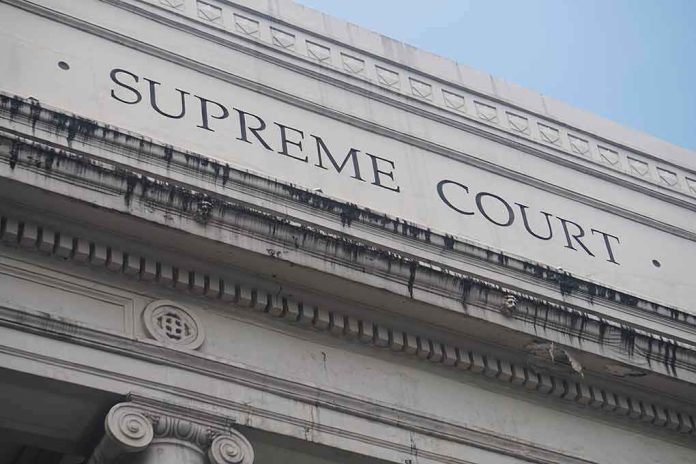
The Supreme Court’s refusal to hear President Trump’s final appeal leaves a $5 million civil judgment standing — a stark reminder that even the most powerful face courtroom limits.
Story Snapshot
- The United States Supreme Court declined Trump’s bid to overturn a $5 million verdict tied to E. Jean Carroll’s claims.
- A New York jury in 2023 found Trump liable for sexual abuse and defamation based on his 2022 denials.
- The United States Court of Appeals for the Second Circuit previously rejected Trump’s immunity argument.
- Court filings show Carroll’s side received over $5.6 million with interest after the ruling stood.
What The Supreme Court Did — And Did Not — Decide
On June 29, 2026, the United States Supreme Court declined to hear President Trump’s renewed appeal over the $5 million civil verdict in E. Jean Carroll’s case. That decision leaves the jury’s findings and lower-court rulings in place, ending this appeal path. Denial of review does not decide the facts again; it affirms the result below by letting it stand. In practical terms, the verdict and related obligations remain enforceable, with no further Supreme Court review on this judgment.
The case stems from Carroll’s claim that Trump assaulted her in a department store in the 1990s and later defamed her by branding her account a “Hoax and a lie” and saying, “This woman is not my type!” in 2022. A New York federal jury found Trump liable for sexual abuse and defamation, awarding $5 million in damages. News coverage tied the verdict to Trump’s 2022 statements rejecting Carroll’s account. Reuters reported the Supreme Court’s refusal to take the appeal.
Why This Verdict Stood Through The Appeals
The legal path matters. The United States Court of Appeals for the Second Circuit ruled in December 2023 that Trump waived a presidential-immunity defense by not raising it in time, undercutting a key procedural shield. That ruling kept the jury’s findings intact. By mid-2026, after the Supreme Court declined review, the case’s result was functionally final. The appellate sequence shows how missed deadlines and settled trial records can lock in outcomes long after the headlines fade.
Money changing hands signaled finality. CNBC reported a court filing that $5,625,005.48 was disbursed to Carroll’s counsel, reflecting the $5 million award plus interest. Payment does not erase disputes over what happened, but it confirms the court’s judgment is being carried out. For many readers, that is the bottom line: years of motions and appeals ended in a concrete transfer, enforced by the system that both parties had to follow.
How Both Sides Are Reading The Moment
Trump has denied Carroll’s allegation from the start, using terms like “hoax,” “lie,” and “not my type,” and he stood by those denials under oath. He argued legal defenses as well, including presidential immunity. The courts, however, sustained the jury’s verdict and left it in place. The Supreme Court’s denial is procedural, not a new factual trial. Still, it closes this avenue and reinforces that even a president must answer civil claims in court.
Supreme Court rejects renewed Trump appeal in E. Jean Carroll case https://t.co/bD5wyFnFHM via @YouTube
— Dystopian🐉🐸🌻💜🇺🇸 (@shell_loyd) August 17, 2026
For Americans across politics, this case highlights deeper worries. Many see a justice system that moves slowly, costs a lot, and feels distant from regular people. Others see proof that the powerful can be held to account only after long, grinding fights. Both reactions can be true. The courts did not relitigate the 1990s episode at the Supreme Court. They enforced a jury verdict, managed appeals, and ended the case by denying review. That is how the system works when institutions stick to process.
What Comes Next — And What It Means For Trust
Looking ahead, the judgment stands, and the payment record shows enforcement. The case also sits within a larger wave of delayed civil abuse claims and high-profile defamation battles. That trend shapes how juries weigh old events and public statements, and how appeals focus on rules and timing. The Supreme Court’s refusal to step in leaves those trial rules and findings in place. For a public skeptical of elites, the message is simple: process, not status, settled this case.
Sources:
abcnews.com, cnbc.com, reuters.com, foxnews.com