

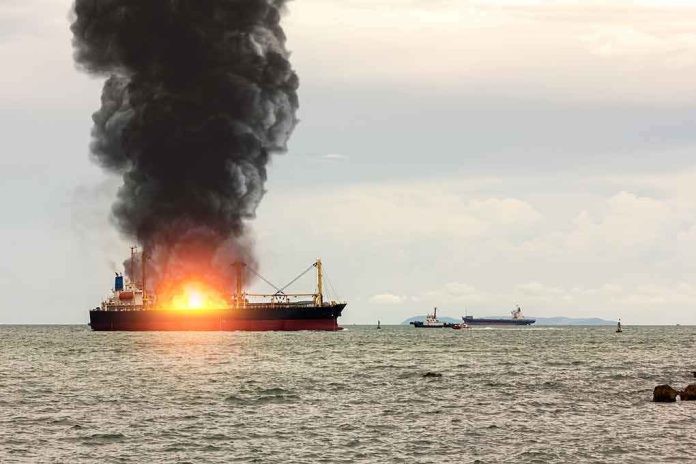
A packed Indonesian passenger ferry bursting into flames at sea has left families begging for answers as at least five people are dead and more than forty are still missing.
Story Snapshot
- Indonesian ferry Mutiara Sentosa 2, with 271 people on board, caught fire off Madura island, killing at least five.
- Rescuers and nearby ships pulled about 225 survivors from the burning vessel, while at least 41 people remain unaccounted for.
- The fire’s cause is still unknown, raising hard questions about basic safety on crowded ferries that many working families depend on.
- The case highlights a wider pattern: overloaded ships, weak oversight, and ordinary travelers paying the price when systems fail.
Ferry Fire Turns Routine Trip Into Deadly Disaster
Indonesian officials say the passenger ferry Mutiara Sentosa 2 was sailing a regular route from Surabaya in East Java to Makassar in South Sulawesi when disaster struck early Sunday morning. The vessel carried 232 passengers and 39 crew, a total of 271 people, when a fire broke out between 6 and 7 a.m. off Sumenep, near the northern tip of Madura island. Search and rescue leaders report that at least five people died in the blaze, while dozens more are missing. For families, a normal trip quickly became a nightmare they could not escape.
Five dead, 41 missing after Indonesian ferry catches fire, authorities say https://t.co/GZ5Ia4INBI https://t.co/GZ5Ia4INBI
— Reuters World (@ReutersWorld) August 2, 2026
Indonesia’s National Search and Rescue Agency, known as Basarnas, says the ferry operator contacted its Surabaya office about an hour after the captain first reported the fire. By then, black smoke was pouring from one side of the ship, and video released by Basarnas shows the vessel wrapped in thick fumes. Some passengers jumped overboard to flee the flames and were later picked up by nearby ships. Others waited as long as they could on deck, hoping help would arrive before the fire reached them. That delay is now part of the growing list of hard questions facing officials.
Rescue Efforts Save Hundreds But Leave Many Missing
Basarnas says that by Sunday afternoon several nearby vessels had managed to rescue 225 passengers and crew and recover five bodies from the water. At least 41 people remained unaccounted for, meaning families still do not know if loved ones survived or were lost at sea. The cargo ship Meratus Project 3 helped locate the burning ferry but could not come close because it was itself carrying flammable cargo. Four other boats waited nearby, ready to assist, but they also had to keep distance from the intense heat and risk of explosion. Those limits show how even willing helpers can be blocked by poor planning and dangerous loads.
Indonesian authorities later deployed nine rescue vessels to reach passengers from the burning ferry, according to police in Sumenep, East Java. Officials say these ships worked to evacuate about 250 passengers and crew from the area around the stricken vessel. Search teams expect casualty numbers to change as they reconcile different counts from ferries, cargo ships, and rescue boats that all pulled people from the water. This kind of confusion is common in ferry disasters, where manifests are often incomplete and boats may be overloaded. The end result is that families wait longer for clear answers while officials sort through conflicting records.
Unknown Cause Highlights Wider Safety Failures
Authorities say the cause of the fire on Mutiara Sentosa 2 is still unknown and under investigation. That uncertainty deepens public anger in Indonesia, a country already scarred by past ferry fires and sinkings where safety rules were weak and enforcement was lax. In one earlier case, a ferry fire in the Java Sea killed at least 15 people, and officials later admitted passenger counts were incomplete and the boat was overloaded. These repeated tragedies show a pattern: ordinary travelers trust public systems that too often fail, while elites and officials promise investigations that rarely fix the root problems.
For Americans watching from afar, this story may feel distant, but the core issue is familiar. Working families used a basic public service—a ferry—to get from one city to another. They trusted that regulators, shipping companies, and government ministries had done their jobs. Instead, they faced a deadly emergency on a crowded vessel with limited escape routes and unclear safety plans. People on both the left and right in the United States share a growing belief that when systems fail, it is regular people who pay the price while those in charge often avoid real accountability. This Indonesian ferry fire is another painful example of that global pattern.
Global Lessons On Oversight, Transparency, And Trust
Indonesia’s search and rescue agency is now working to locate anyone still missing and to explain how a routine voyage turned into a mass casualty event. That means tracking down the full passenger manifest, crew list, and cargo details to see whether the ship was overloaded or carried risky materials without proper safeguards. This is not just a local concern. Around the world, crowded ferries, aging trains, and worn-down bridges are daily reminders that safety often takes a back seat to profit, speed, and political comfort. Every time officials shrug off those risks, ordinary travelers shoulder them instead.
Americans who are frustrated with the “deep state” at home, and who feel both parties have ignored basic infrastructure and safety, can see parallels in this tragedy. Indonesian families trusted a system run by distant agencies and powerful companies, and now they are left with grief and unanswered questions. Their loss echoes the concern many citizens worldwide share: that those in charge—whether in Jakarta or Washington—focus more on protecting their own positions than on protecting human life. Events like this ferry fire should push governments everywhere to put safety, transparency, and real accountability ahead of political theater.
Sources:
washingtonpost.com, euronews.com, en.antaranews.com, bbc.com