

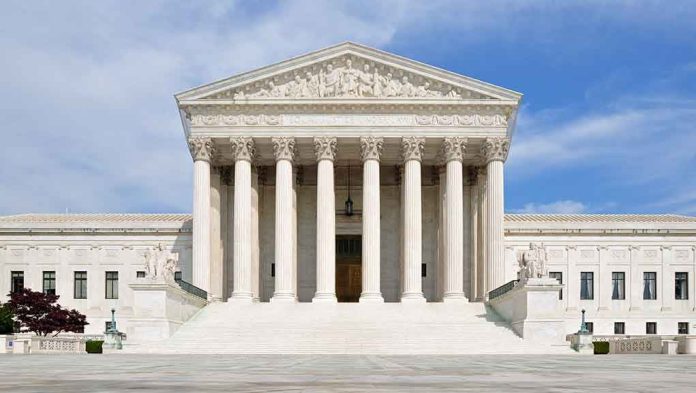
The Supreme Court just gave the President sweeping new power over dozens of federal watchdogs, raising fresh questions about who really keeps Washington in check.
Story Snapshot
- The Court ruled 6-3 in Trump v. Slaughter that the President can fire Federal Trade Commission leaders at will, overturning 91 years of precedent.
- By striking down “for cause” job protections, the Court effectively put most once‑independent regulatory agencies under direct White House control.
- Chief Justice John Roberts grounded the ruling in a strong “unitary executive” view of the Constitution, saying presidential subordinates must be removable at will.
- A separate case the same day kept special protection for the Federal Reserve, showing the Court will shield some economic powers even as it weakens others.
Supreme Court Breaks With Nearly a Century of Tradition
On June 29, 2026, the Supreme Court decided Trump v. Slaughter, a case about whether Congress can protect leaders of the Federal Trade Commission from being fired without good cause. In a 6-3 vote along ideological lines, the Court said the President may remove Federal Trade Commission commissioners at will, for policy reasons or any reason at all. The justices overturned their own 1935 decision in Humphrey’s Executor, which had allowed Congress to create independent agencies with “for cause” removal limits.
Chief Justice John Roberts wrote the majority opinion, calling the Federal Trade Commission’s “for cause” removal rule “contrary to the separation of powers enshrined in the Constitution.” He argued that the Constitution gives “the Executive Power” to a single President, who must be able to remove any official who carries out his authority. In Roberts’ view, if an official uses the President’s power, that official must stay fully accountable to the President, and the President stays accountable to the people.
From Independent Referees to Presidential Team Players
For decades, agencies like the Federal Trade Commission were designed to stand somewhat apart from day‑to‑day politics, enforcing rules on business, finance, labor, and safety. Congress tried to shield their leaders with fixed terms and “for cause” protections, usually tied to serious misconduct or clear failure, so that no President could simply purge them over policy fights. By striking down these protections at the Federal Trade Commission and overruling Humphrey’s Executor, the Court signaled that similar agencies exercising executive power will now be treated as part of the President’s direct chain of command.
Legal analysts say the ruling is the latest step in a long march toward a stronger “unitary executive” theory, which holds that all federal executive power flows through the President alone. Past cases chipped away at limits on firing single directors of powerful agencies; this decision extends that logic to multi‑member commissions that most Americans never vote for but that shape key parts of daily life. Supporters call this a return to clear lines of responsibility: voters can blame or reward the President for agency action. Critics warn it removes a core check on both parties, making it easier for any President to pressure regulators or punish watchdogs who push back.
A Narrow Escape for the Federal Reserve Highlights Bigger Tensions
On the same day, in a companion case known as Trump v. Cook, a different 5-4 majority treated the Federal Reserve as a special exception. That ruling allowed Federal Reserve Governor Lisa Cook to stay in her role while her challenge continues, and it recognized the central bank’s unique place in the economy and in constitutional history. The Court suggested that the Federal Reserve’s independence from direct presidential control is economically vital, even as it tore down similar protections at roughly two dozen other agencies.
President Trump said a Supreme Court ruling affirmed his authority to remove executive branch officials, calling it a major expansion of presidential power. https://t.co/j32yvrfa2t
— TheMAGANewsroom (@TheMAGAnewsroom) July 13, 2026
This split outcome sends a mixed message that many Americans will recognize from their own frustrations. On one hand, the President gains more power over regulators that shape markets, workplaces, and consumer protections, which worries people who already see “the deep state” and big corporations as too cozy. On the other hand, the Court kept special guardrails around the Federal Reserve, an institution many blame for favoring Wall Street over Main Street, reinforcing a sense that the most powerful economic actors still get extra protection.
Why This Matters for Everyday Americans Across the Political Spectrum
For conservatives frustrated with unelected bureaucrats blocking “America First” policies, this ruling looks like a long‑sought victory: the President can now clear out agency leaders who resist elected priorities and replace them with allies. Business groups and some legal scholars argue it will bring more democratic control, saying that major regulatory choices should follow the results of national elections. They view the decision as restoring a clearer balance between Congress writing laws and the President enforcing them without hidden vetoes from entrenched officials.
For liberals concerned about weakened consumer protections, worker rights, and safeguards for minorities, the same ruling feels like a serious threat. Advocacy groups warn that agencies handling whistleblower claims, market abuses, and workplace disputes could become more vulnerable to political pressure, making it harder to challenge powerful interests. Both sides, however, share a deeper worry that cuts across ideology: when the Court reshapes power in Washington this sharply, it can appear less like a neutral referee and more like another player in a system many already see as serving elites over ordinary citizens.
Sources:
reason.com, abcnews.com, wiley.law, newsbreak.com, bbc.com, cnbc.com, supremecourt.gov, npr.org, scotusblog.com, niada.com, supreme.justia.com