

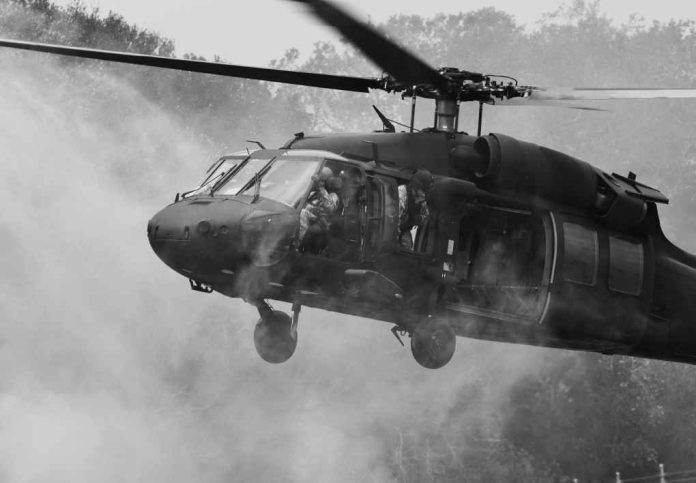
As flash floods cut off a Missouri summer camp, eight Army Black Hawk helicopters raced in and flew 202 kids and counselors to safety.
Story Snapshot
- More than 200 campers and staff were trapped at Camp Taum Sauk after roads washed out in sudden flooding.
- Governor Mike Kehoe activated the Missouri National Guard, which deployed eight Black Hawk helicopters to evacuate 202 people.
- All campers and counselors were flown to a nearby elementary school and reunited with their families with no reported deaths.
- The mass rescue shows government can act quickly in a crisis, even as many Americans doubt federal and state leaders.
Flooding Turns Summer Camp Into Emergency Zone
Heavy storms dumped 6 to 12 inches of rain on south central Missouri, turning streams and rivers into raging floodwaters and washing out roads in hours. At Camp Taum Sauk near Lesterville, water rose so fast that normal escape routes disappeared, stranding more than 200 children and staff. Troopers and local emergency crews reported that campers were safe but cut off, with no way to drive in or out. Families watched terrifying video of water pouring over nearby dams and feared the worst. For many parents, the American dream felt small compared to one urgent question: would the government show up in time?
Early reports on social media said “over 150” people needed helicopter rescues from the camp. As the operation continued and officials combined their counts, Governor Mike Kehoe’s office confirmed a final number of 202 campers and counselors. This kind of shift is common in disasters, when fast-moving events make it hard to tally everyone at once. What mattered most for families was not the number but the outcome. Every child and counselor at Camp Taum Sauk was found, evacuated, and reported safe.
Black Hawk Airlift: How The Rescue Worked
Governor Kehoe declared a state of emergency and activated the Missouri National Guard to respond to the historic flash flooding. Eight UH-60 Black Hawk helicopters, staffed by about 35 crew members, were sent directly to Camp Taum Sauk. Guard pilots flew into the flooded Ozark valley, loaded campers in groups, and ferried them out over the high water. The helicopters carried all 202 children and counselors to Arcadia Valley Elementary School, where local first responders helped organize reunions with waiting families. Videos from the scene show kids lining up on the football field, each group walking to emotional parents and guardians.
National and local outlets, including CBS News and Fox News, reported the airlift as a rare bright spot in a day filled with disaster headlines. The Army National Guard helicopters did more than a single camp mission. They were part of a wider rescue effort across Reynolds County and nearby areas, where crews pulled people from trees, rooftops, and cars caught in fast-moving water. Governor Kehoe later said there were more than 200 water rescues in the region, with urban search and rescue teams handling at least 100 of them. In total, officials estimated hundreds of Missourians were saved from dangerous floodwaters in just one day.
What This Operation Reveals About Our Systems
For many Americans on both the left and the right, stories about government often focus on failure, waste, or corruption. This rescue shows another side. In this case, the state’s emergency system worked the way people hope it will. Leaders declared an emergency, activated the National Guard, and moved real hardware—eight Black Hawk helicopters and dozens of trained crew—into place fast enough to save over 200 children. Parents who often mistrust “the system” saw the same system lift their kids out of danger in under a day.
FOR IMMEDIATE RELEASE
Boone County Fire Protection District Deploys Specialty Teams to Assist Historic Flooding Response in Reynolds, and Iron Counties.
BOONE COUNTY, Mo. — July, 11th 2026 — The Boone County Fire Protection District (BCFPD) deployed multiple specialty… pic.twitter.com/TNp9cCX5JU
— Boone County Fire (@BooneCountyFire) July 11, 2026
At the same time, the broader picture still feeds public frustration. Historic flash flooding is becoming more common, and records show that floods have killed more than 1,000 people statewide over recent decades. Many citizens feel leaders talk about climate, infrastructure, and disaster preparedness but rarely invest enough to protect small towns before crisis hits. The Camp Taum Sauk rescue was a victory, but it depended on last-minute heroics and expensive military equipment. That raises a hard question for voters across the spectrum: why do we wait for catastrophe before using the tools we already have?
Flash Floods, Ordinary Families, And Trust In Government
Camp Taum Sauk is a traditional summer camp built around simple values: fresh air, rivers, and time away from screens. Parents send kids there believing the country is still safe enough for childhood adventures in the woods. When sudden flash floods turned that retreat into a danger zone, those same families had to trust distant institutions—state command centers, the National Guard, and emergency managers—they often criticize in daily politics. The fact that every child came home alive may slightly rebuild that trust, at least in times of clear crisis.
Yet once the helicopters fly away and the cameras leave, these families return to a world where the cost of living keeps rising, infrastructure ages, and political fights stall long-term fixes. Many conservatives see the flood damage as proof that green energy rules and federal spending choices have weakened power grids and roads. Many liberals see the same event as evidence that “America First” does not do enough for vulnerable communities at home. Both sides can look at Camp Taum Sauk and agree on one thing: when systems fail upstream, it is ordinary people—often children—who end up needing a miracle flight out.
Sources:
facebook.com, moguard.ngb.mil, worldwar1centennial.org, governor.mo.gov, wbaltv.com, instagram.com, ncei.noaa.gov