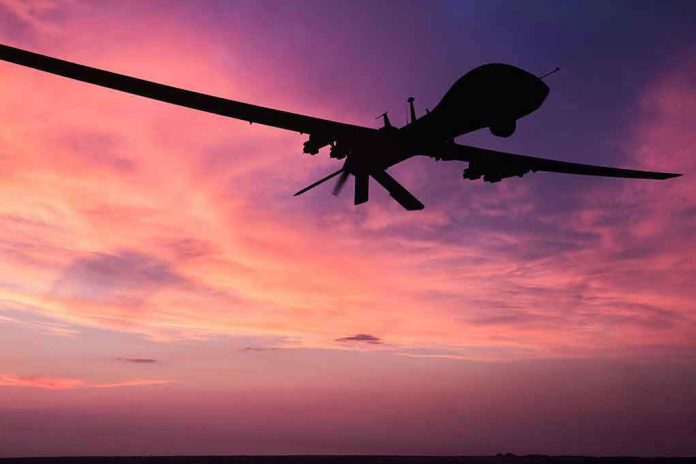
A mysterious drone swarm just slipped over one of France’s most sensitive nuclear submarine bases, raising urgent questions about Western readiness in an age of cheap, weaponizable technology.
Story Snapshot
- Small drones briefly penetrated airspace over France’s main nuclear ballistic submarine base at Île Longue.
- The incident exposed how vulnerable critical nuclear deterrent sites are to low-cost drone incursions.
- French authorities opened an investigation, but early details remain sparse and tightly controlled.
- The episode is a stark warning for NATO, especially the U.S., to harden bases against high-tech probing and sabotage.
French Nuclear Sub Base Faces Unprecedented Drone Intrusion
French defense officials launched an investigation after security teams at the Île Longue naval base detected a small drone incursion on December 4, 2025. The site houses all four of France’s ballistic missile submarines, which carry the country’s sea-based nuclear deterrent. Reports from major French news outlets stated that multiple small drones appeared over or near restricted airspace around the peninsula, triggering alarm among military leadership and prompting immediate security and intelligence reviews.
Initial accounts described the drones as “small” and likely commercially derived, yet precise technical details, including range, payload capacity, or any recovered components, have not been released. Security personnel reportedly detected the aircraft using base surveillance assets and standard airspace monitoring procedures. French authorities have not confirmed whether the drones launched from land, sea, or another platform, leaving open critical questions about the operators’ sophistication, intent, and potential foreign backing or probing activity.
Strategic Importance of Île Longue in France’s Nuclear Deterrent
Île Longue, located in Brittany, is the hardened home port for France’s fleet of nuclear-armed ballistic missile submarines, often considered the ultimate insurance policy for national survival in a major conflict. These submarines provide France’s second-strike capability, meaning they can retaliate even if land-based forces are struck first. Any intrusion near this base therefore carries weight far beyond a typical airspace violation and touches directly on strategic stability for both France and NATO allies.
Because ballistic missile submarines are designed to stay hidden and survivable, the security around their bases is normally tight, multilayered, and classified. The presence of unidentified drones over such an installation potentially opens windows into base layout, patrol routines, and defensive blind spots, especially if equipped with cameras or sensors. Even a brief overflight can yield high-resolution imagery useful to hostile states, terror organizations, or sophisticated criminal networks seeking leverage, cyber targets, or options for future sabotage.
Drones, Hybrid Warfare, and Vulnerabilities in the West
Recent global conflicts have demonstrated how cheap drones can punch far above their weight, providing surveillance, target correction, and even kamikaze attack capabilities over high-value military sites. The Île Longue incident aligns with broader patterns of gray-zone or hybrid warfare, where adversaries probe defenses without firing a traditional shot. Unclaimed drone incursions let hostile actors test response times, radar coverage, and rules of engagement while retaining plausible deniability and avoiding immediate escalation.
Western militaries, including France and the United States, have invested heavily in advanced fighters, submarines, and missile systems, yet many installations still struggle with low-cost, commercially available drones that can be modified with off-the-shelf components. The French investigation will likely examine whether existing counter-drone tools—such as jamming, sensor fusion, and kinetic interceptors—were adequate or if doctrine and equipment lag behind the evolving threat. Limited public data means the effectiveness of any defensive response at Île Longue remains unclear.
Implications for U.S. and NATO Security Under Trump’s America-First Focus
For American readers, a drone over a French nuclear submarine base is not a distant curiosity; it is a warning shot for every nation that depends on strategic deterrence. U.S. ballistic missile submarine bases, nuclear storage depots, and critical infrastructure are prime targets for similar probing. The current Trump administration has emphasized hardening the homeland, securing borders, and rebuilding military readiness, but the rapid rise of unmanned threats requires continual updates to base defense plans and investment in counter-drone innovation.
The incident also underscores why many conservatives argue against complacency and globalist wishful thinking about security. Adversaries are clearly willing to test Western red lines using new technologies that exploit legal and operational gray areas. While details from Île Longue remain sparse, the episode reinforces a basic principle: deterrence is only as strong as the physical security and technological resilience of the facilities that support it. Limited data is available, so key insights must be drawn cautiously from the early reporting.
Sources:
Drone Incursion at French Navy Nuclear Submarine Base