

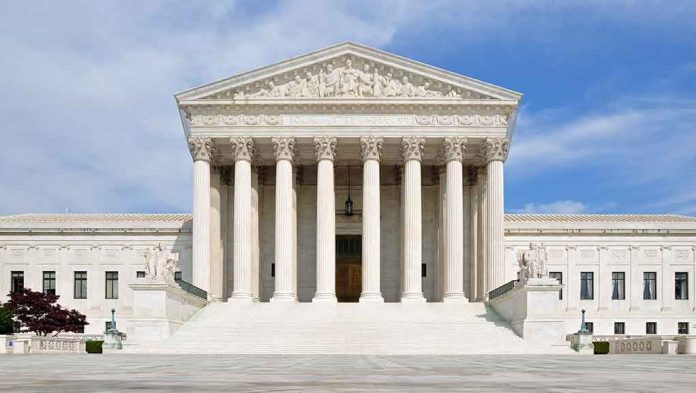
In a rare 9–0 ruling, the Supreme Court just told Washington it cannot quietly strip gun rights from millions of sober marijuana users just because they do not follow federal drug rules.
Story Snapshot
- The Supreme Court unanimously struck down using a federal gun ban against a sober, habitual marijuana user, calling it inconsistent with the Second Amendment.
- Justice after justice rejected the idea that a vague “unlawful user” label lets the government disarm people for years with no proof they are dangerous.
- The ruling limits how the federal government can use 18 U.S.C. § 922(g)(3), a law long used to turn drug “status” into a serious gun crime.
- The decision highlights a deeper problem both left and right see: a distant federal system that punishes ordinary people while pretending it is keeping them safe.
What The Court Actually Decided
On June 18, 2026, the Supreme Court unanimously ruled that the federal government could not use 18 U.S.C. § 922(g)(3) to prosecute Ali Danial Hemani, a Texas man who admitted to using marijuana regularly while keeping a handgun at home for self-defense.[3] The law makes it a felony for any “unlawful user” of a controlled substance to possess a gun, and the government had argued that Hemani’s status as a habitual user was enough, even though it never claimed he was high while he had the firearm.[2] The justices instead agreed with the Fifth Circuit Court of Appeals, which had already found the law unconstitutional as applied to a sober gun owner, because it lacked support in our nation’s historical tradition of gun regulation.[5]
Writing under the Second Amendment framework set by the Court’s earlier Bruen decision, the justices focused on history: at the founding, lawmakers sometimes barred people from carrying guns while drunk, but they did not impose open-ended bans on sober people based only on their status as users of alcohol or other substances.[5] That distinction matters. The Court held that the government cannot convert a broad, fuzzy label like “unlawful user” into a near-automatic, years-long loss of a fundamental right without clear proof of present danger.[3] The ruling does not erase every limit tied to drugs and guns, but it blocks the federal government from treating millions of marijuana users as if they were all armed felons in waiting.
JUST IN🚨: The Supreme Court just sided with a Second Amendment challenge to the federal law that bars drug users from owning guns. The case involved Texas man Ali Danial Hemani, who was charged after FBI agents searched his home in 2022 and found a legally purchased pistol along… pic.twitter.com/k6Zs8dg4jU
— Melissa Hallman (@dotconnectinga) June 18, 2026
How Hemani’s Case Exposed A Bigger Federal Power Grab
Hemani’s case began like many modern federal prosecutions: during an investigation, he admitted he used marijuana several times a week, and agents found a handgun he kept at home.[1] He was not accused of dealing drugs, threatening anyone, or carrying the gun while high; his own words about personal use were enough to trigger the “unlawful user” gun charge.[1] A federal trial judge threw out the indictment, and the Fifth Circuit affirmed, stressing that the government had not shown he was intoxicated or dangerous when he possessed the weapon.[5] That narrow record made Hemani a test of how far Washington could go in punishing personal behavior that many states now tolerate or even welcome.
For the government, the stakes were huge. The Justice Department urged the Court to revive the case and defended the statute as a “temporary” bar on “habitual” drug users, likening it to older laws disarming so-called habitual drunkards.[5] But civil-liberties and free-market groups, including the American Civil Liberties Union and the Liberty Justice Center, answered that no founding-era law supported permanently disarming sober citizens just because they used a disfavored substance.[1][4] Their briefs warned that the vague “unlawful user” label had become a blank check to strip rights from tens of millions of Americans—often with no individual finding that they posed any real threat.[1]
Why This Ruling Resonates With Frustrated Americans On Both Sides
This decision lands at a time when a growing share of Americans on the right and left feel the federal system is working for insiders, not ordinary people. Many conservatives see § 922(g)(3) as one more example of Washington using gun laws to chip away at the Second Amendment for people who have never hurt anyone. Many liberals see the same law as part of a failed drug-war approach that criminalizes personal choices, clashes with state marijuana reforms, and falls hardest on minorities and the poor. The Hemani case forced the Court to confront both concerns at once.
By rejecting status-based disarmament for a sober marijuana user, the justices pushed back on the idea that bureaucrats can quietly label broad groups “too risky” for rights without proving actual danger. That is a pattern many people recognize in other areas: watchlists, speech policing, and complex rules that only experts and lobbyists can navigate. The ruling does not end mistrust in the system, but it shows that at least in this fight, the Court was willing to put a constitutional limit on how far federal power can reach into private life, even when both major parties have been comfortable using that power for years.[3]
What Changes Now — And What Still Has You In The Crosshairs
For millions of Americans who use marijuana in states where it is legal, the Hemani ruling offers real relief but not total safety. The Court made clear that the government cannot treat every unlawful user as if they are armed and dangerous simply because they consume a banned substance, and that is likely to force changes in how federal agents and prosecutors handle gun cases tied to cannabis.[3][5] Lower courts that once relied on § 922(g)(3) as an easy add-on charge will now have to ask harder questions about actual impairment and risk.
At the same time, the decision stops short of saying that any drug-related gun restriction is always unconstitutional. The opinion leaves room for laws that target people who are proven to be intoxicated while armed, or who have been found by a court to be genuinely dangerous, which matches the narrower historical examples the justices found acceptable.[5] That means the fight over how far the federal government can go is far from over, especially as marijuana remains illegal under federal law and agencies show little interest in giving up easy tools of control. For readers who see a deep state that rarely gives back power once it takes it, Hemani is both a welcome win and a warning that the government will likely look for new ways to police the same people under different names.
Sources:
[1] Web – Supreme Court sides with man who challenged law barring drug users …
[2] Web – US v. Hemani | American Civil Liberties Union
[3] Web – Guns, Cannabis, and the Constitution: SCOTUS to Hear United …
[4] Web – Should Hemani be Decided as a Statutory Case?
[5] Web – United States v. Hemani – Liberty Justice Center